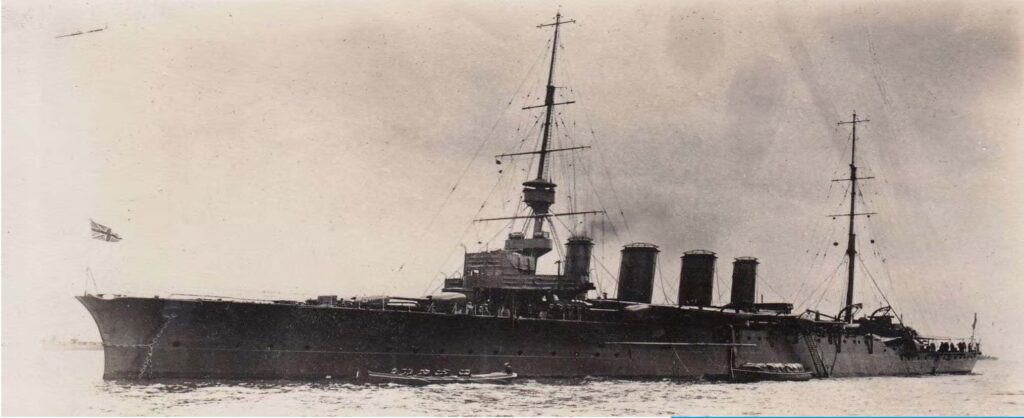
The last unlocated Royal Navy cruiser from the First World War has been found 60 miles off the Northumberland coast by an international team of technical divers — in remarkably preserved condition, with all nine of her guns still in place.
A century-long mystery resolved
The wreck of HMS Nottingham, a Royal Navy Town-class light cruiser sunk by a German submarine on August 19, 1916, has been located on the floor of the North Sea by ProjectXplore, a community-led shipwreck exploration initiative. The discovery, made in April 2025 following eight months of archival research, brings to a close one of British naval history’s longest-standing mysteries. Nottingham was the last unlocated cruiser lost by the Royal Navy during the First World War.
The wreck lies at a depth of approximately 82 meters, around 60 miles offshore, resting at a 45-degree list to port — exactly as described by survivors who watched the ship go down more than a century ago. Royal Navy historians formally confirmed the identification in July 2025.
How the ship was found
The ProjectXplore team, led by Dan McMullen and Leo Fielding, began their research in September 2024, working through records held at the National Archives, the National Maritime Museum, and the Imperial War Museum in London. A key breakthrough came from an unexpected source: the war diary of U-52, the German submarine responsible for sinking Nottingham. The document, which includes a grid reference and a sketch of the attack, placed the wreck in open water well outside the areas previously searched.
A side-scan sonar survey conducted from the research vessel MV Jacob George in April 2025 confirmed the target on the first day of the search. The wreck’s dimensions — 139 meters long by 15 meters beam — matched Nottingham’s specifications exactly. Divers made their first descent to the site in July 2025 to conduct a detailed survey and document the wreck’s condition.
Remarkably preserved after more than a century
What the divers found exceeded expectations. All nine of Nottingham’s 6-inch guns remain in their original positions, with unspent shells visible nearby. The ship’s wooden decking is largely intact, her four distinctive funnels are still recognizable, and Royal Navy dinnerware — white plates bearing the blue crown emblem — was found undisturbed near the bridge. Divers also documented the ship’s name embossed across the stern, adjacent to a porthole looking into the captain’s day cabin.
The torpedo damage is clearly visible forward of the bridge on the port side, consistent with both British survivor accounts and the entries in U-52’s war diary. Experts describe Nottingham as the best-preserved Town-class cruiser currently known to exist.
The ship’s history and final moments
Completed at Pembroke Dockyard on April 1, 1914, HMS Nottingham served throughout the major naval engagements of the First World War, including the Battle of Heligoland Bight in 1914, the Battle of Dogger Bank in 1915, and the Battle of Jutland in May 1916 — the largest naval battle of the war. On the morning of August 19, 1916, while screening ahead of the Grand Fleet as part of the 2nd Light Cruiser Squadron, Nottingham was struck by three torpedoes fired by U-52 in a coordinated ambush. She sank within approximately 90 minutes. Of her roughly 480-man crew, 38 were killed — some of them teenagers. More than 375 sailors were rescued by accompanying destroyers.
Accounts from survivors indicate that Nottingham’s crew continued firing at the submarine until the ship went under, and that sailors remained aboard until the last possible moment as the captain worked to shore up the vessel’s watertight bulkheads.
A protected war grave
The site carries formal protected status as an official war grave, and the ProjectXplore team conducted their dives with explicit permission from the Royal Navy. No artifacts were removed. The wreck is expected to remain a protected underwater memorial to the 38 men who lost their lives when Nottingham sank — and to the broader human cost of naval warfare in the North Sea during the First World War.
Related Posts

NYPD investigates two separate groups caught on video entering and exiting Brooklyn sewers in the middle of the night — motives unknown
Surveillance footage from two locations in Brooklyn captured more than…

Tapo C210 Avis (2026) : La Meilleure Caméra de Surveillance Intérieure Pas Chère ?
Tapo C210 : Avis Complet 2026 — La Caméra de…
Trump blames Iran for downing U.S. Apache helicopter near Hormuz — both crew rescued by Navy drone boat in a military first
An AH-64 Apache attack helicopter went down off the coast…
