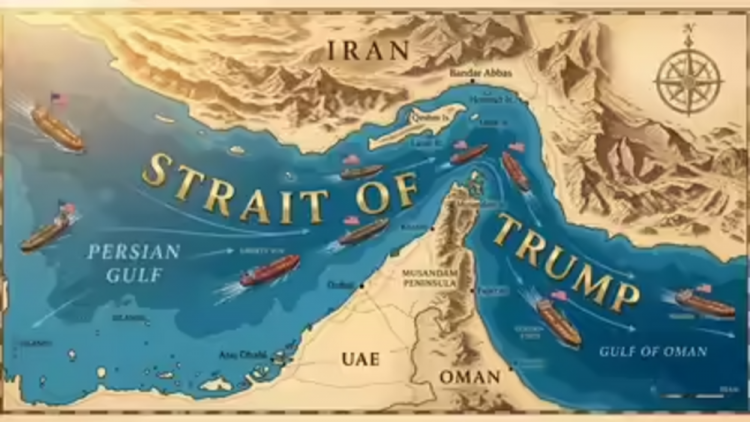
The post, shared on Truth Social on April 30, depicts vessels flying American flags transiting freely through the strategically vital waterway — a symbolic gesture made as the U.S. naval blockade of Iranian ports enters its third week.
A symbolic post in the middle of an active conflict
President Donald Trump reshared an AI-generated image on Thursday showing the Strait of Hormuz relabeled as the “Strait of Trump,” with ships bearing U.S. flags moving through the passage unimpeded. The post carries clear symbolic weight: the strait has been effectively closed to most international shipping for the past two months, disrupted first by Iranian restrictions and subsequently by the U.S. naval blockade targeting Iranian ports, which took effect on April 13.
Blockade strategy expected to continue long-term
According to reporting by The Wall Street Journal, Trump has directed his national security team to prepare for a prolonged naval blockade against Iran, a strategy the administration views as preferable to renewed airstrikes or a withdrawal from the conflict. The blockade has already stopped or redirected dozens of vessels, and U.S. Central Command has deployed more than 10,000 personnel and a fleet of warships to enforce it across the Gulf of Oman and the Arabian Sea.
White House officials have stated that the blockade is costing Iran an estimated $500 million per day in lost oil revenue, with Iranian crude exports collapsing sharply since the measure took effect.
Iran ties reopening to end of conflict
Iranian authorities have maintained that any full restoration of commercial navigation through the strait is contingent on the cessation of hostilities and credible security guarantees for vessels operating in the region. Tehran has also insisted on the removal of the U.S. naval blockade as a precondition for resuming diplomatic talks — a condition Washington has so far refused to accept.
The impasse follows the breakdown of negotiations held in Islamabad in mid-April, which ended without agreement on either the nuclear question or the status of the strait.
Global energy markets remain under pressure
The Strait of Hormuz carries approximately 20 percent of the world’s oil supply under normal conditions. The ongoing disruption to shipping through the corridor has contributed to rising fuel prices globally, with U.S. gasoline prices reaching levels not seen since the period immediately following Russia’s invasion of Ukraine. A prolonged blockade, with no diplomatic resolution in sight, suggests energy market volatility is unlikely to ease in the near term.
Related Posts

Principia Creme Hidratante Facial: Vale a Pena em 2026?
Um hidratante nacional com fórmula de dermocosmético, ingredientes ativos transparentes…
New York Police Tightens Security After Shooting Incident at Trump Dinner
Authorities in New York have increased security measures following the…
An IPO — short for Initial Public Offering — is the process through which a private company begins selling shares on the stock market for the first time, allowing public investors to buy ownership stakes in the business.
The topic has returned to global attention after growing speculation…
