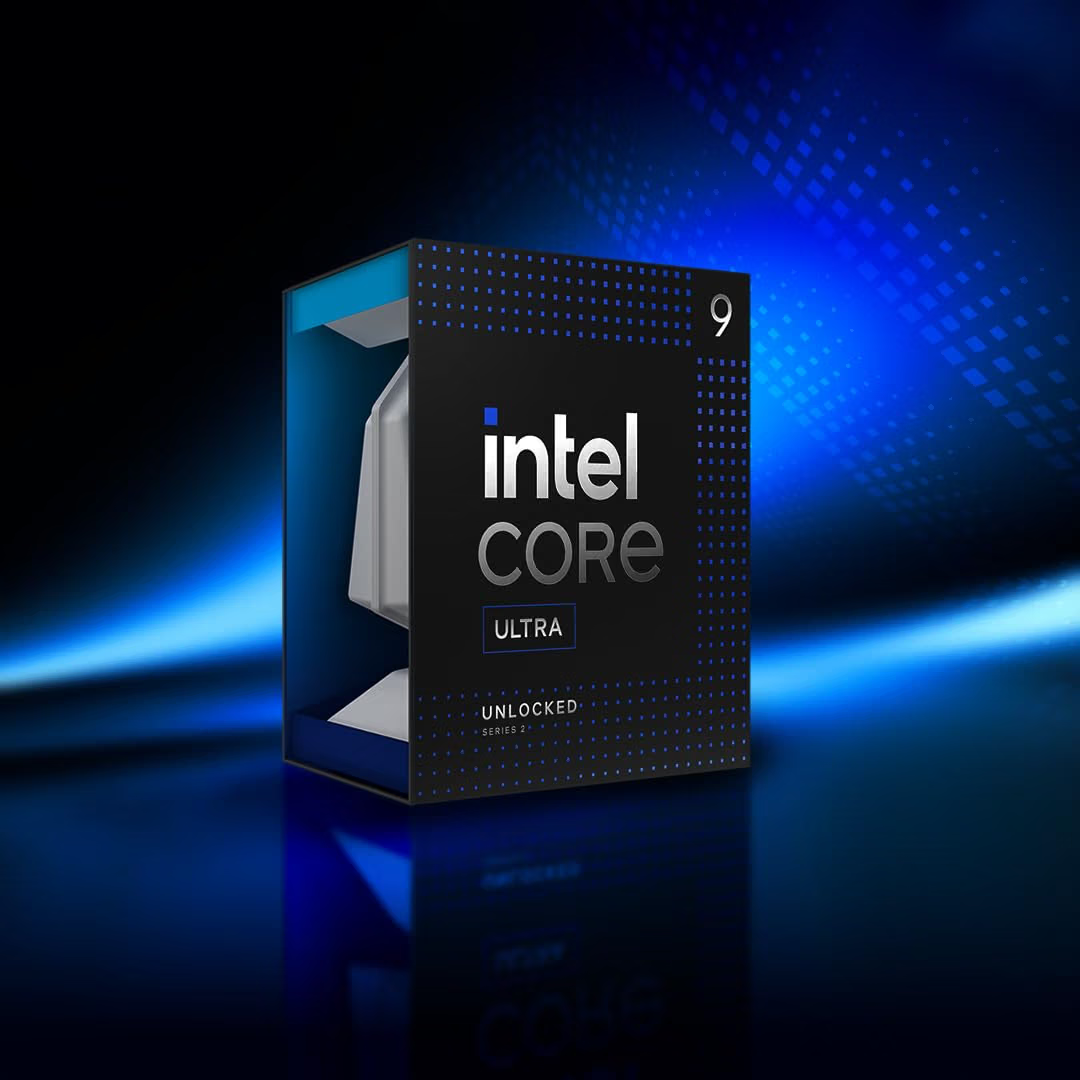

Intel Core Ultra 9 285K Review
The Core Ultra 9 285K is Intel’s flagship desktop processor built on the new Arrow Lake architecture, and it represents a genuinely significant redesign rather than an incremental refresh. It drops Hyper-Threading entirely, moves to a hybrid layout of 8 performance cores and 16 efficiency cores (24 threads total, down from the 32 threads its 14900K predecessor offered), boosts up to 5.7 GHz, and is manufactured on TSMC’s 3nm process rather than Intel’s own fabs — a first for one of Intel’s flagship chips. It requires a new LGA1851 socket and Z890 motherboard, so this isn’t a drop-in upgrade for existing Intel systems. We pulled together testing from GamersNexus, Tom’s Hardware, TechPowerUp, and several other independent labs, and the picture that emerges is consistent but genuinely two-sided.
Where it clearly excels: efficiency
This is the chip’s strongest, most consistently verified selling point. TechPowerUp’s testing found gaming power draw dropped by roughly 50W compared to the outgoing 14900K, down to about 94W, and Tom’s Hardware measured the 285K pulling around 6W per frame in HandBrake encoding — a large improvement over the entire previous generation of Intel processors. NoobFeed’s independent testing found similar results: 4K gaming power draw came in 50–60W lower than the 14900K, and heavy productivity loads used roughly 35–40% less power. Temperatures followed the same pattern — NoobFeed measured the 285K running at 60–65°C during demanding 4K ray-traced gaming, compared to 70–72°C for the 14900K under identical conditions, and multiple reviewers noted that cooling this chip, historically a real pain point for Intel flagships, is now essentially a non-issue.
This efficiency gain is real and independently confirmed across several labs, and it opens up genuine practical benefits: quieter systems, more overclocking headroom at a given thermal budget, and viable small-form-factor builds that older Intel flagships couldn’t support comfortably.

Where it clearly struggles: gaming
This is the most important, most consistently repeated criticism across nearly every review, and it’s worth taking seriously rather than treating as a minor footnote. GamersNexus’s review was blunt: AMD’s Ryzen 7 7800X3D is far superior for gaming and for efficiency in that specific use case, and the 285K’s price isn’t easily justifiable if gaming is your main workload. One detailed benchmark writeup measured the 285K running 8% slower than the outgoing 14900K and 12% behind AMD’s 7800X3D across 15 games tested at 1080p with an RTX 4090 — a real regression rather than a wash, with 1% low frame rates telling an even less flattering story than the averages. In Cyberpunk 2077 specifically, that testing recorded 142 fps on the 285K against 156 fps on the 14900K.
The likely technical culprit, according to multiple outlets, is memory latency: the new chiplet-based Arrow Lake design increased memory latency to roughly 81–90ns, compared to around 60–72ns on Intel’s 12th through 14th-generation chips. Games tend to be more latency-sensitive than many productivity workloads, which helps explain why gaming results specifically lag behind Intel’s own older flagship in several tests, even as the new chip wins comfortably in other categories.
To be fair to Intel, this gap narrows significantly at higher resolutions, where the graphics card becomes the bottleneck rather than the CPU — if you’re gaming at 4K with a high-end GPU, the real-world difference shrinks. And GamerBenchmark’s testing, which scored the chip 96/100 for gaming, found it handles CPU-intensive titles like Starfield and Cities: Skylines 2 without issue and avoids bottlenecking high-end GPUs in most scenarios — a more favorable read that suggests the gap matters most specifically at 1080p with top-tier graphics cards, not universally.
Productivity and multi-threaded work: a genuine strength
Outside of gaming, the picture turns positive again. Yahoo Tech’s Geekbench 6 testing of the related 285 variant found roughly 12–13% multi-core and single-core gains over the previous-generation Core i9-14900, and Hardware Busters’ reviewer, while acknowledging disappointment from some peers over the gaming results, was clear that the efficiency gains represent a genuinely positive step for Intel — describing this as closer to what the 13900K and 14900K should have been from the start. For rendering, video encoding, and other heavily multi-threaded workloads, multiple reviewers rate the 285K as a strong, efficient performer.
Pricing: the sticking point
At its original MSRP of roughly $589–$630, several reviewers questioned the value proposition directly. GamersNexus specifically called out that for non-gaming applications the chip is interesting, but at this price it’s hard to justify given AMD’s competing options. TechPowerUp’s conclusion echoed this, pointing out that several AMD Ryzen chips (the 9600X, 7700X) and even Intel’s own 14600K and 13700K are priced roughly $200 lower with plenty of competitive performance in this segment. If your workload is gaming-focused specifically, the value math gets harder to defend against AMD’s 7800X3D at this price point.
Platform cost is a real add-on
Because this requires a new LGA1851 socket and Z890 motherboard, factor that into your total budget — this isn’t a simple CPU swap for anyone on an older Intel platform, and the new socket has no backward compatibility with existing coolers’ mounting in some cases, so double-check compatibility before you buy.
Pros and Cons
Verdict
The Core Ultra 9 285K is a genuinely two-sided chip, and the honest takeaway depends heavily on what you actually do with your PC. If your workload leans toward rendering, encoding, multitasking, or other multi-threaded productivity work, the efficiency gains are real, well-documented across multiple independent labs, and represent legitimate progress for Intel after years of criticism over power draw and heat. If gaming is your primary use case, especially at 1080p or 1440p with a high-end GPU, the data is consistently less flattering — several credible benchmarks show it trailing both AMD’s 7800X3D and Intel’s own previous-generation flagship, which is an unusual thing to see from a new “flagship” release. Add in the cost of a new motherboard platform, and multiple reviewers concluded the pricing doesn’t clearly justify the chip for gaming-first builds. If you’re building primarily for content creation or heavy multitasking, this is a reasonable, efficient choice. If gaming performance is your top priority, it’s worth cross-shopping AMD’s X3D lineup before committing.

Related Posts
Intel Core Ultra 9 285 (Non-K) Review: Nearly 285K Performance, Far Less Power — But Check What You’re Actually Buying
Intel Core Ultra 9 285 (Non-K) Review An important clarification…

DASH Rapid Egg Cooker Review: Is the $20 Egg Gadget Worth It?
DASH Rapid Egg Cooker Review If you've spent any time…

ANCEL AD310 OBD II Scanner Review: The Beginner’s Check Engine Light Fix
Overview The ANCEL AD310 Classic Enhanced Universal OBD II Scanner…
