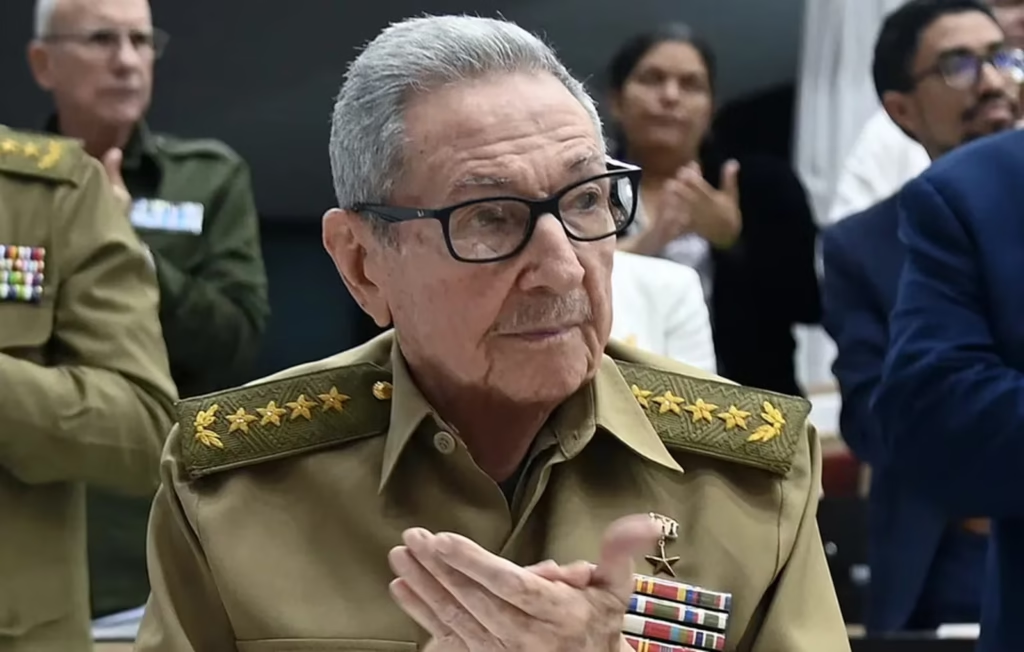
Raúl Castro has once again become a central figure in international headlines after U.S. authorities formally indicted the former Cuban leader on murder-related charges connected to a 1996 military incident.
The indictment accuses Castro and former Cuban military officials of involvement in the shooting down of two civilian aircraft operated by the anti-Castro humanitarian group “Brothers to the Rescue,” an event that killed four people, including three American citizens. U.S. prosecutors allege Castro personally authorized the operation while serving as Cuba’s defense minister.
Born in 1931, Raúl Castro became one of the main figures of the Cuban Revolution alongside his brother Fidel Castro and Argentine revolutionary Che Guevara. The revolutionary movement overthrew the U.S.-backed government of Fulgencio Batista in 1959, establishing communist rule in Cuba that continues today.
For decades, Raúl Castro served as:
- Cuba’s defense minister,
- head of the armed forces,
- vice president,
- and later president of Cuba after Fidel Castro stepped down due to health problems.
He officially became Cuba’s president in 2008 and remained in power until 2018, later handing leadership to Miguel Díaz-Canel while still maintaining strong political influence within the Cuban Communist Party.
During his years in power, Raúl Castro was viewed internationally as both:
- a key architect of Cuba’s military system,
- and a pragmatic political operator who introduced limited economic reforms.
His administration allowed:
- small private businesses,
- expanded tourism,
- internet growth,
- and a temporary diplomatic thaw with the United States during Barack Obama’s presidency.
At the same time, critics accused the Cuban government of:
- authoritarian rule,
- suppression of dissent,
- political imprisonment,
- and human rights abuses.
The current indictment represents one of the most significant legal actions ever taken by the United States against a former Cuban leader. Prosecutors allege the 1996 aircraft attack occurred over international waters and was intentionally ordered against unarmed civilians.
Cuban authorities strongly rejected the accusations, describing them as politically motivated and part of broader U.S. pressure against the communist government.
The case has also intensified geopolitical tensions between:
- the United States,
- Cuba,
- and regional allies,
especially as the Trump administration increases pressure on Havana through sanctions, diplomatic actions, and military signaling in the Caribbean region.
Online reactions to the indictment have been sharply divided. Some Cuban exile communities celebrated the charges as overdue justice, while critics questioned whether the move could further escalate tensions between Washington and Havana.
At 94 years old, Raúl Castro remains one of the final surviving leaders directly connected to the original Cuban Revolution, making the indictment both historically symbolic and politically explosive.
Related Posts
Fed Shake-Up: What It Means for Your Money in 2026
The era of Jerome Powell at the U.S. Federal Reserve…
US Searches for Explosives in Strait of Hormuz to Restore Shipping Routes
The United States has launched an operation to locate and…
Open-ended ceasefire: what led Trump to delay a new offensive against Iran
Lack of response from Tehran, internal divisions, and economic pressure…
