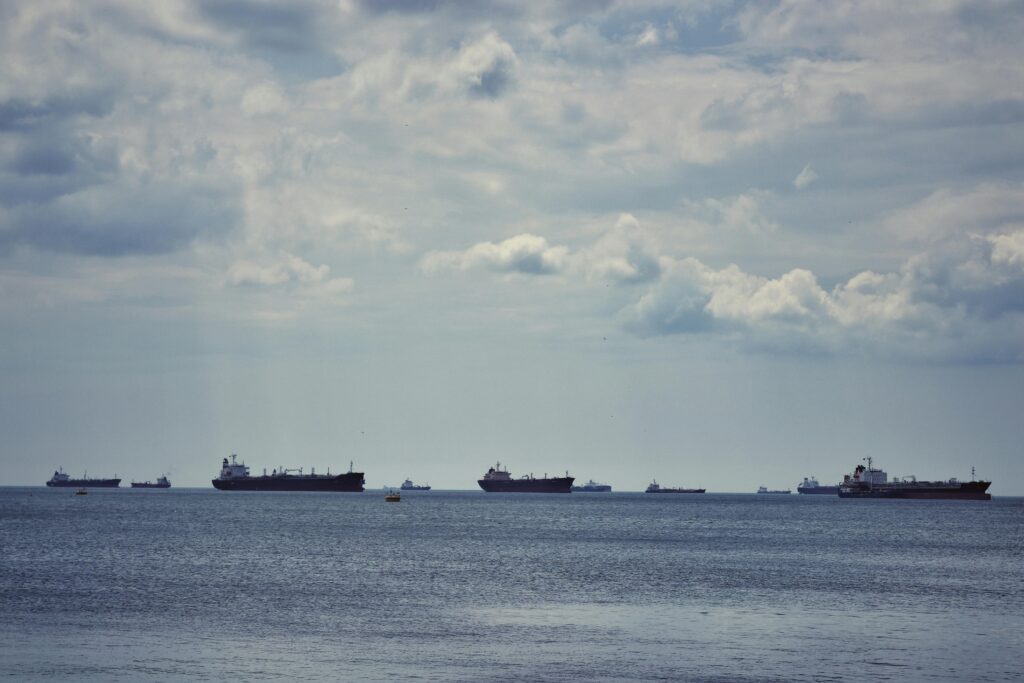
Speaking on May 1, President Trump described a massive backlog of tankers unable to transit the strait and said oil prices would fall sharply once a deal with Iran is reached even as markets remain under sustained pressure from the largest energy supply disruption in modern history.
Hundreds of tankers trapped in the Persian Gulf
President Trump stated on Thursday that approximately 400 oil tankers are currently stranded in the Persian Gulf, unable to transit the Strait of Hormuz due to the combined effect of Iran’s restrictions on vessel movement and the U.S. naval blockade of Iranian ports. The figure is consistent with independent shipping data: about 20,000 mariners and 2,000 ships are stranded in the Persian Gulf due to the crisis, with tanker traffic having dropped to near zero since Iran closed the strait in the early weeks of the conflict. The backlog represents billions of dollars in cargo unable to reach global markets.
Trump’s forecast: oil will fall sharply once the war ends
Despite the current surge in energy prices, Trump expressed confidence that a resolution to the conflict would trigger a rapid decline in oil costs. Trump says gas prices will plummet when the Iran war ends — a prediction that reflects the White House’s view that the price shock is temporary and tied directly to the physical obstruction of the strait rather than to any structural supply deficit. However, energy analysts have pushed back on that assessment. Prices will be supported even after the war ends by new demand for stockpiling, heightened insurance and freight costs associated with the Strait of Hormuz, and a broader geopolitical risk premium in the market, according to commodity strategists.
The scale of the energy disruption
The closure of the Strait of Hormuz has triggered what analysts describe as the largest oil supply disruption in modern history. On 19 March, Dubai crude oil prices reached US$166, their highest on record. Brent crude has since fluctuated between $94 and $126 a barrel depending on diplomatic signals, while U.S. gasoline prices have reached levels not seen since the aftermath of Russia’s invasion of Ukraine. Nearly 1 billion barrels will be lost by the end of the month, comprising up to 600 million barrels of crude oil and roughly 350 million barrels of refined products, according to estimates by TD Securities.
~400
tankers stranded in Persian Gulf
20%
of global oil normally transits Hormuz
$126
Brent crude peak (per barrel)
Cascading effects on food and everyday costs
Iran has closed the Strait of Hormuz to oil tankers, keeping them pent up in the Persian Gulf and away from customers worldwide, while a U.S. Navy blockade is preventing Iran from selling its own oil. The knock-on effects extend well beyond the pump. Fuel accounts for roughly 15% to 30% of the total cost of food, and about 30% of the world’s fertilizer shipments typically pass through the Strait of Hormuz. The U.N. World Food Programme has warned that 45 million additional people — the majority of whom live in Asia and Africa — could tip into hunger if the war doesn’t ease by the middle of this year, bringing the global total facing food insecurity to a record 363 million.
Market sensitivity to diplomatic signals
Oil markets have proven highly reactive to any hint of progress in the negotiations. Oil prices plunged after the U.S. and Iran agreed to a two-week ceasefire that allows safe passage through the Strait of Hormuz, with WTI falling more than 16% in a single session — its steepest one-day decline since April 2020. Conversely, the breakdown of subsequent talks has sent prices surging again. On May 1, prices dropped noticeably following Iran’s announcement that it had submitted a new proposal through Pakistani mediators, reflecting the market’s sensitivity to even partial diplomatic progress.
International pressure to reopen the strait
The humanitarian and economic scale of the disruption has prompted an expanding international response. France has deployed a naval strike group — including the Charles de Gaulle aircraft carrier to the Mediterranean and Red Sea, with potential deployment toward Hormuz. Macron outlined plans for a multinational escort mission designed to shepherd tankers and container ships back through the Strait of Hormuz once the heaviest fighting subsides. The United States has also circulated invitations to allied nations to join the Maritime Freedom Construct, a proposed coalition to enforce safe navigation through the corridor.
An uncertain path to lower prices
Trump’s prediction that oil will fall sharply once the war ends may prove directionally correct but the timeline and magnitude remain deeply uncertain. With negotiations stalled, the blockade in place, and Iran’s new proposal still unreviewed by Washington, the conditions for a rapid reopening of the strait do not yet exist. Until the physical obstruction is removed and tanker traffic normalizes, global energy markets are likely to remain volatile regardless of what either side says publicly about the prospects for a deal.
Related Posts
Wreck of WWI cruiser HMS Nottingham discovered in the North Sea after 109 years
The last unlocated Royal Navy cruiser from the First World…

Review: Interruptor Smart Positivo Casa Inteligente Vale a Pena em?
Se você quer começar a transformar sua casa em uma…
US Accuses China of Large-Scale Theft of AI Technology
From above of roll of dollar bills tied with rubber…
