Washington announced on Sunday it would begin escorting stranded vessels out of the Persian Gulf on Monday. Iran responded with an explicit military threat — and within hours, reports emerged of a tanker being struck and a U.S. warship reportedly being forced to turn back.
Trump’s “Project Freedom” — what was announced
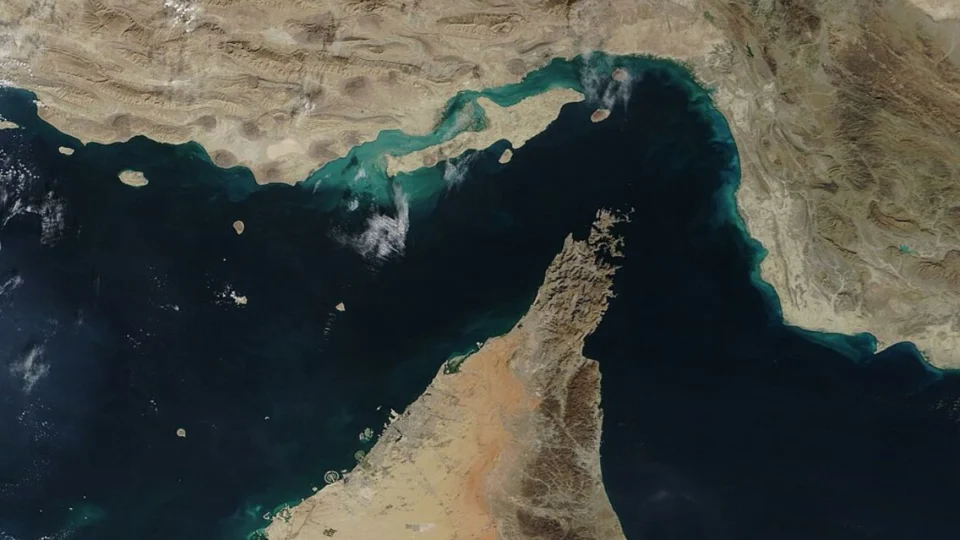
In a post on Truth Social on Sunday, May 3, President Trump announced that the United States would launch an operation beginning Monday to escort ships stranded in the Strait of Hormuz out of the waterway. Trump described the initiative — which he called “Project Freedom” — as a humanitarian gesture on behalf of neutral countries whose vessels have been trapped in the Persian Gulf since Iran closed the strait in March, roughly two months into the U.S.-Israeli war against the Islamic Republic.
“For the good of Iran, the Middle East, and the United States, we have told these Countries that we will guide their ships safely out of these restricted Waterways, so that they can freely and ably get on with their business.”
— President Donald Trump, Truth Social, May 3, 2026
Trump added that crew members aboard stranded vessels were running low on food and essential supplies, and warned that any interference with the operation would “unfortunately, have to be dealt with forcefully.” U.S. military support for Project Freedom is to include guided-missile destroyers providing air cover, according to defense officials.
Iran’s response: an explicit threat of force
Tehran responded swiftly and in unambiguous terms. Major General Ali Abdollahi, head of the Iranian armed forces’ unified command, issued a formal statement warning that any foreign military force — specifically naming the U.S. Navy — would be attacked if it attempted to approach or enter the Strait of Hormuz.
“We warn that any foreign armed forces, especially the aggressive U.S. army, will be attacked if they intend to approach and enter the Strait of Hormuz.”
— Maj. Gen. Ali Abdollahi, Iranian Armed Forces Unified Command, May 4, 2026
Abdollahi added that Iran maintains full control over the security of the waterway and that all commercial ships and oil tankers must coordinate with Iranian forces before attempting any transit — or risk endangering their own security. Iran’s Foreign Ministry described the U.S. as unable to escape its “self-made quagmire” and reiterated that Tehran considers itself the guardian of the strait.
Reported incidents on the first day of the operation
The situation deteriorated rapidly on Monday. Iran’s semi-official Fars news agency — affiliated with the Islamic Revolutionary Guard Corps — reported that two missiles struck a U.S. warship near the southern end of the strait. The U.S. military flatly denied the report: U.S. Central Command stated that no Navy ships had been struck, and an Axios journalist with access to U.S. defense officials confirmed no vessel had been hit by Iranian fire.
Iran separately claimed that a U.S. warship attempting to enter the strait was forced to turn back after receiving an Iranian warning. The U.S. did not confirm or directly address that claim. Additionally, the United Kingdom Maritime Trade Operations agency reported that a tanker off the coast of Fujairah in the UAE had been attacked, though details remained unclear at the time of publication. The UKMTO kept the maritime security threat level in the strait at critical and advised commercial mariners to consider routing through Oman’s territorial waters, where the U.S. has established an enhanced security corridor.
A direct collision with the ceasefire
Al Jazeera’s correspondent in Tehran reported that Iran views any U.S. military entry into the strait as a violation of the ceasefire that came into effect on April 8 — the truce that paused the U.S.-Israeli bombing campaign against Iran. Iranian officials have made clear that the war has fundamentally altered the rules governing the waterway, and that Tehran intends to maintain control over vessel movement regardless of what Washington announces.
The ceasefire has already been under strain. Diplomatic talks held in Islamabad last month ended without a breakthrough, Iran submitted a 14-point proposal that Washington has described as containing “excessive and unreasonable demands,” and the U.S. naval blockade of Iranian ports — in place since April 13 — has remained fully operative throughout the ceasefire period.
Diplomatic back-channel still active — barely
Despite the escalating rhetoric on the ground, Trump noted in the same Truth Social post that U.S. representatives are engaged in “very positive discussions” with Iran, and suggested the talks “could lead to something very positive for all.” Iran’s Foreign Ministry confirmed it had received a U.S. counterproposal via Pakistan, but spokesman Esmaeil Baghaei said it was “not easy to review” given what he described as Washington’s pattern of excessive demands. He declined to discuss specifics, and dismissed media reports about nuclear negotiations as speculation.
The gap between the two sides on the core issues — Iran’s nuclear program, the fate of its highly enriched uranium stockpile, and the conditions for lifting the blockade — remains as wide as it has been at any point since the ceasefire took effect.
Energy markets and the broader stakes
Oil prices initially fell after Trump’s Sunday announcement, as traders interpreted Project Freedom as a potential signal of easing tensions. They steadied through Monday morning as the scope of Iran’s counter-threat became clear. With approximately one-fifth of the world’s daily oil supply and a similar share of global LNG trade normally transiting the strait, any escalation that deepens the disruption — or any credible progress toward reopening — will continue to move markets sharply.
Commodity strategists have warned that the oil market is weeks away from a tipping point that could drive prices significantly higher if the blockade and strait closure persist into summer. Project Freedom, for all its boldness as a unilateral declaration, has done nothing yet to change those fundamentals — and may have made the immediate path to a negotiated resolution considerably more complicated.
Related Posts

Garnier Hyaluron Fresh & Plump : La Crème Sorbet Repulpante Vaut-elle le Coup en 2026 ?
Texture sorbet ultra-légère, acide hyaluronique, niacinamide et 98 % d'ingrédients…
Trump Calls Iran Proposal “Stupid” as Middle East Peace Negotiations Face Major Breakdown Risk
US President Donald Trump criticized Iran’s latest negotiation proposal, calling…
US Awaits Iran Response on Peace Deal as Marco Rubio Signals Critical Turning Point in Middle East Crisis
The United States is awaiting Iran’s official response to a…
