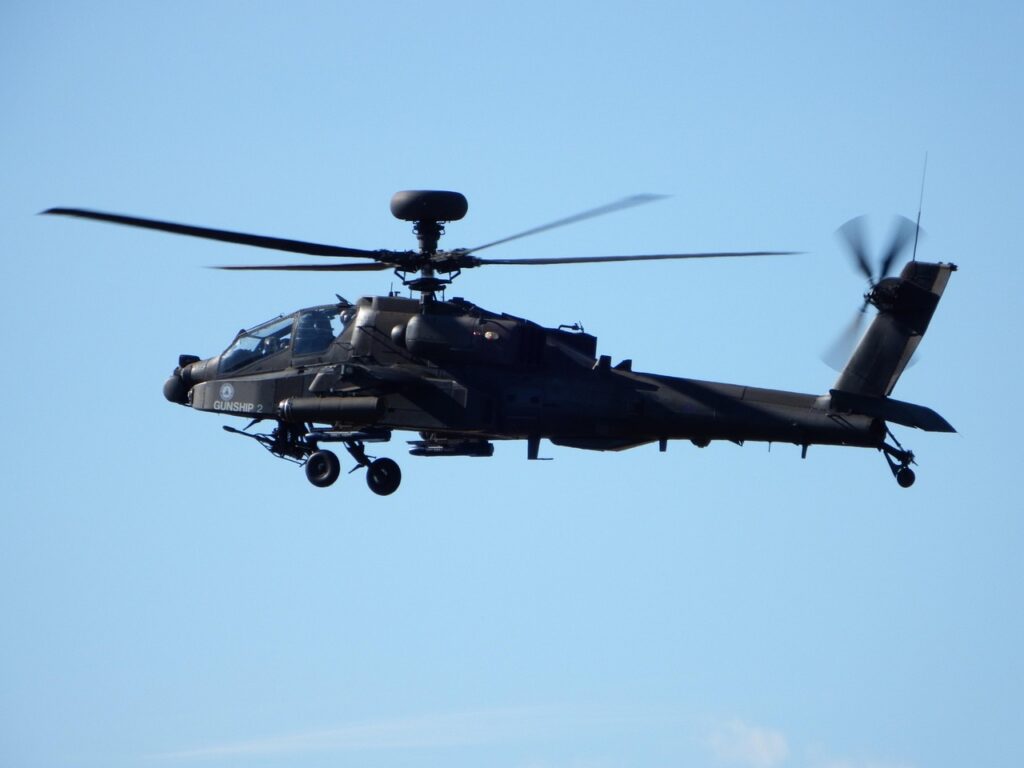
An AH-64 Apache attack helicopter went down off the coast of Oman at 3:30 a.m. local time Tuesday while patrolling the Strait of Hormuz. Both aviators were found in the water and rescued by an unmanned surface vessel — the first drone boat rescue in U.S. military history. Trump says an Iranian Shahed drone brought it down and has pledged a U.S. response.
What happened
A U.S. Army AH-64 Apache attack helicopter went down near the coast of Oman at approximately 3:30 a.m. local time Tuesday while on a patrol of the Strait of Hormuz region. The two-man crew survived and were rescued after spending approximately two hours in the water. The crew was rescued by a U.S. Navy Corsair unmanned surface vessel operated by U.S. 5th Fleet’s Task Force 59 — in what CENTCOM spokesman Capt. Tim Hawkins described as the first known drone rescue at sea by the U.S. military. Both soldiers are in stable condition.
“I have just been informed by our Great Military that last night the Iranians shot down one of our highly sophisticated Apache Helicopters while patrolling over the Strait of Hormuz. There were two pilots involved, both are safe and uninjured. Nevertheless, the United States must, of necessity, respond to this attack.”
— President Donald Trump, Truth Social, June 9, 2026
Key confirmed facts
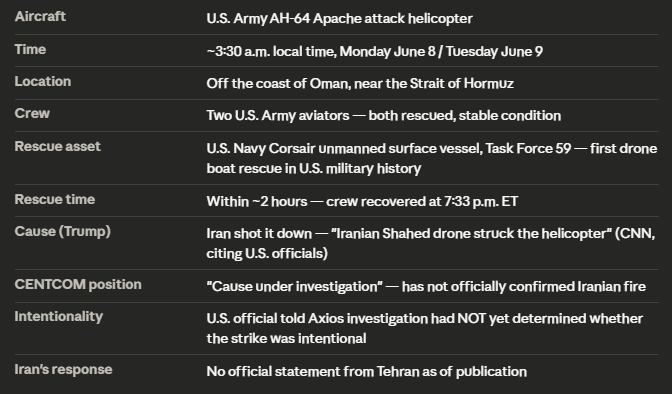
⚠️ Key distinction: Trump has publicly attributed the downing to an Iranian Shahed drone. CENTCOM says the cause is still under investigation and has not officially confirmed Iranian fire. A U.S. official told Axios the investigation has not determined whether the strike was intentional. Treat the Iranian attribution as the current U.S. government’s public position — not yet confirmed by independent military investigation.
A historic first: drone boat rescues crew in combat zone
The surface drone that carried out the rescue was a U.S. Navy Corsair unmanned surface vessel operated by U.S. 5th Fleet’s Task Force 59. The Task Force began fielding these drones in theater in late March. The Corsair is a 38-foot autonomous surface vessel capable of operating in contested maritime environments where crewed vessels would face higher risk. Its use as a search-and-rescue platform — finding two aviators in the water at night in the Strait of Hormuz region — represents a significant operational milestone for the Navy’s unmanned systems program, which has expanded dramatically since the Iran war began.
The context: ceasefire on the verge of collapse
The helicopter went down as the Middle East was still reeling after Iran and Israel exchanged fire the previous day in the biggest blow yet to the strained ceasefire in the Iran war, with Trump urging both sides to show restraint. Iranian state television reported Tuesday that the Israeli attacks killed at least two members of the country’s air-defense units.
Hours before the Apache went down, CENTCOM reported that an F/A-18 Super Hornet from USS Abraham Lincoln struck a commercial tanker, the Marivex, in the Gulf of Oman after its crew failed to comply with orders from U.S. forces. The tanker was reportedly heading toward Iran. The sequence of events — Israeli strikes on Iran, the Marivex incident, and now the Apache downing — represents the most compressed and dangerous escalation window since the ceasefire of April 8.
The economics of the incident
Brent crude has risen by nearly 31 percent since hostilities began in late February 2026, with prices spiking to nearly $120 a barrel at their peak. War risk insurance premiums for tankers transiting the waterway have climbed from approximately 0.25 percent of hull value before the conflict to as much as 5 percent. The International Monetary Fund warned in early June 2026 that global oil inventories are expected to sink to a five-year low by July 2026. Oil prices moved immediately on news of the incident.
Trump vows a response — with negotiations still active
Trump’s pledge that the U.S. “must, of necessity, respond” is the most direct military threat he has issued since declaring Operation Epic Fury over on May 5. It comes at an extraordinarily delicate moment: the tentative agreement framework that had been reported in late May has not been formally signed, negotiations via Pakistani mediators remain nominally active, and any U.S. military response to the Apache incident risks permanently collapsing the diplomatic track.
Trump said he had just learned Iran was responsible before posting his accusation, and separately told reporters he thought a deal was going well — “We have a good chance of doing it. We should be able to do it in one hour if you want to know the truth.” The simultaneous threat of retaliation and optimism about a deal reflects the same paradox that has defined the conflict since the ceasefire: both sides are simultaneously fighting and negotiating, with neither willing to be the first to fully stop doing either.
Related Posts
Pakistan Delivers Revised Iranian Proposal to the U.S. in Effort to End War
Pakistan has reportedly delivered a revised proposal from Iran to…

Google Confirms Gmail Storage Test That Could Reduce Free Accounts to 5GB
Google has officially confirmed it is testing a major change…
Explosions heard in Iran’s Bandar Abbas and near the Strait of Hormuz — cause unknown, situation “under control” per Iranian state media
Three explosions were reported in the southern Iranian port city…
