

Overview
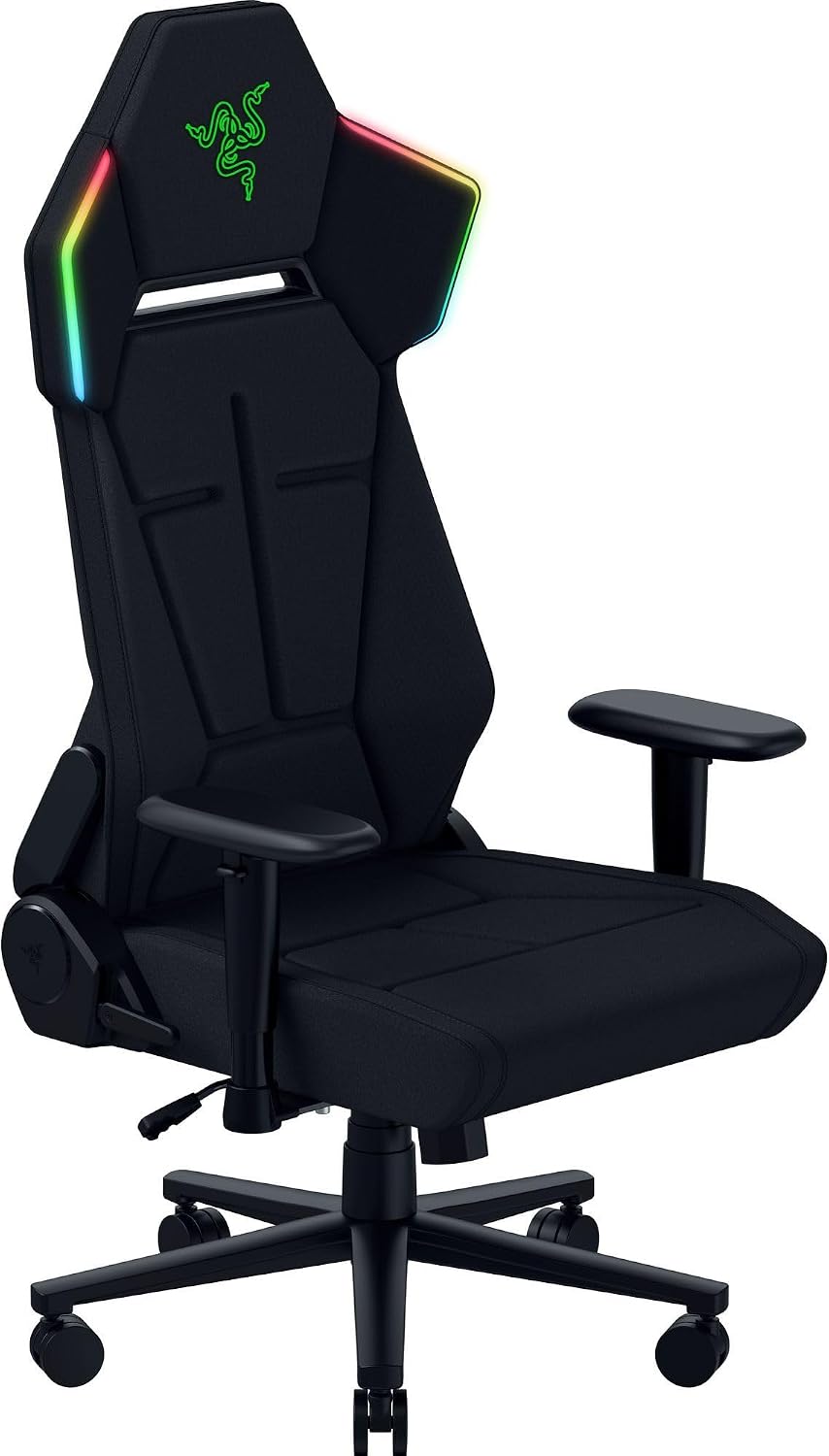
This review covers the Razer Soma Chroma, a $499.99 gaming chair that marks Razer’s first entry into what the company calls its “immersive furniture” line. It’s built around a reinforced steel frame, dual-density cold-cured foam cushioning, a built-in (non-adjustable) lumbar arch, 2D armrests (height and inward/outward swivel), and a five-star wheel base, with 155-degree recline. The headline feature is fully integrated Razer Chroma RGB lighting on the headrest, which can display 16.8 million colors, run preset lighting effects, and react in real time to more than 300 supported games via Razer’s Synapse software. It runs wirelessly, connecting to your PC via a 2.4GHz USB dongle or Bluetooth LE, and draws power from a USB-C connection.
Razer states the chair is designed for users between roughly 5’3″ and 6’6″ in height, with a recommended weight capacity of 331 pounds (150 kg). This is a single product configuration with no size variants — it’s one chair, one set of dimensions.
Comfort and Build Quality
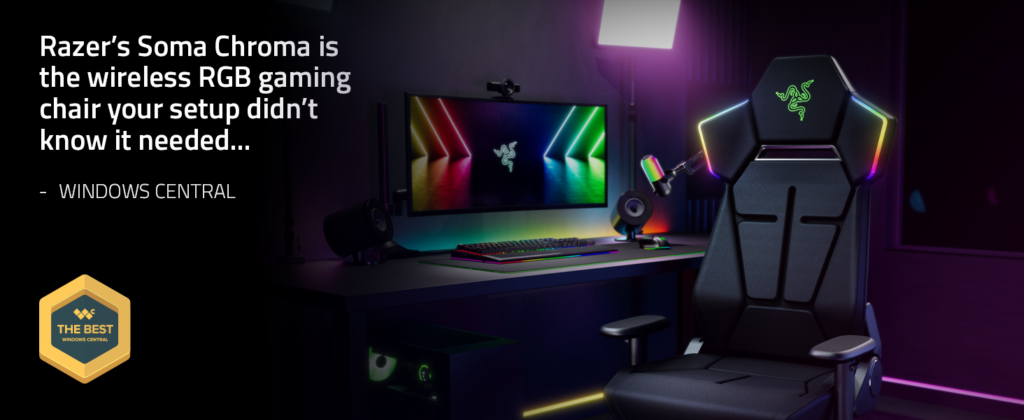
This is where the Soma Chroma earns genuinely strong, consistent praise across nearly every review we found — and it’s worth taking seriously, since several reviewers went in expecting the RGB gimmick to be the whole story and came away more impressed by the fundamentals. TechRadar’s reviewer, who has tested many gaming chairs, specifically called it one of the most comfortable chairs they’d ever sat in, praising the soft-touch fabric finish and surprisingly wide base. Windows Central independently reached a similar conclusion, describing the dual-density foam and ergonomic lumbar arch as making the chair feel like a genuine comfort upgrade rather than just an RGB stunt. Shacknews and Gamerant both echoed this, with the Gamerant reviewer noting they used it comfortably for dozens of hours across gaming, work, and reading. MMORPG.com’s review specifically called the build quality “very solid” and noted a straightforward, under-30-minute assembly process with everything needed included in the box.
There is one dissenting data point worth including for balance: Tom’s Hardware’s reviewer reported experiencing some minor lower back pain during extended use in their preferred seating position, noting they hadn’t experienced this with previous Razer chairs — a reminder that chair comfort is genuinely individual and can vary by body type and sitting posture, even when the broader consensus is positive.

The RGB Lighting: Where Reviews Genuinely Diverge
This is the most important, honest thing to communicate clearly, because press opinion is genuinely split here rather than settled — and a fair review shouldn’t paper over that. On one side, Windows Central’s reviewer was won over, describing the reactive lighting as executed with high-quality materials and genuine novelty value, and Shacknews found the effect neat and immersive, specifically highlighting how the lights flashed red when taking damage in Cyberpunk 2077.
On the other side, the criticism is substantial and comes from multiple independent outlets. Gamerant’s reviewer called the Chroma lighting a gimmick that most people would see as a cute novelty rather than a meaningful feature, and — more pointedly — both Shacknews and Gamerant independently flagged the same fundamental design flaw: the LEDs sit on the sides of the headrest, which means you can’t actually see them while sitting in the chair looking at your monitor. You’d have to turn around or catch a reflection to notice the effect at all, which somewhat undermines the entire “immersive gaming” pitch, since the person supposedly immersed by the lighting is the one least likely to see it. TechRadar went further, specifically noting that Razer expects you to separately buy a cable, power bank, and (for some builds) a headrest pillow to get the full lighting experience, and predicted many buyers will enjoy the lighting for a day and then largely forget about it. Gizmodo’s review leaned into calling the whole concept “weird,” framing it as an interesting but not fully realized first step toward the more ambitious haptic/audio “immersive furniture” concept (called Project Madison) that Razer showed at CES 2026 but didn’t ship in this model.
Adjustability: A Real Limitation
Multiple reviewers flagged the same specific shortcoming here, which adds credibility to it as a genuine limitation rather than one outlet’s nitpick. Tom’s Hardware noted the chair lacks 3D armrests and adjustable lumbar controls, which are common on higher-end ergonomic chairs. Windows Central was more pointed, specifically criticizing the 2D armrests for only allowing height and basic inward/outward angling, with no forward, backward, or lateral sliding — a real omission on a $499.99 chair, in their view, especially if you’re coming from a chair with more advanced armrest articulation. The lumbar support itself is fixed and built-in rather than adjustable, unlike Razer’s own ergonomic-focused Iskur V2, which offers a more sophisticated HyperFlex lumbar system.
TechRadar also noted a related practical limitation: the braked casters and static armrests make this a chair built for sitting relatively still, rather than one designed for a lot of shifting or movement at your desk.

Price and Value
This is really the crux of nearly every review’s verdict, and it’s worth stating plainly. At $499.99, the Soma Chroma costs a genuine $200 premium over Razer’s own Iskur V2 X, which multiple reviewers — including Tom’s Hardware and MMORPG.com — noted shares many of the same core comfort fundamentals without the RGB system. Tom’s Hardware’s conclusion was direct: if you don’t specifically want the RGB lighting, the cheaper Iskur V2 X is “just as good on chair fundamentals” for less money. MMORPG.com framed the entire review around this same central question — whether the lighting justifies the premium — and the general consensus across outlets leans toward “not really, unless the aesthetic specifically matters to you.” Windows Central offered the most positive framing on price, arguing that relative to what a future, more elaborate “immersive” chair might eventually cost, $499.99 feels reasonable for the novelty and comfort on offer today — but this is very much a minority framing compared to the more skeptical value assessments elsewhere.

How It Compares
Within Razer’s own lineup, the honest comparison is against the Iskur V2 and Iskur V2 X, which TechRadar specifically recommended as an alternative for buyers who want similar or better ergonomic sophistication (including adjustable lumbar support) without paying for lighting they may rarely see. Outside Razer, TechRadar also pointed to the Secretlab Titan Evo 2022 as a strong alternative for buyers prioritizing broad size range and removable magnetic lumbar support over any lighting features. If your priority is genuinely aesthetics and setup theater — streaming, content creation, or building out a fully coordinated RGB battlestation — the Soma Chroma is a more unique, purpose-built option than any of these alternatives.
Pros and Cons
Verdict
The Razer Soma Chroma succeeds as a genuinely comfortable, well-built gaming chair — that part of the reviews is remarkably consistent, and if comfort and build quality were the only factors, this would be an easy recommendation. Where opinion genuinely splits is on whether its signature feature, the reactive RGB lighting, is worth the $200 premium it commands over Razer’s own cheaper Iskur V2 X, which multiple reviewers say matches it on chair fundamentals. If you’re deeply invested in Razer’s Chroma ecosystem, want a genuinely unique aesthetic centerpiece for your setup, and don’t mind that the lighting is mostly visible to other people rather than to you while gaming, this is a fun, well-executed piece of “gamer furniture.” If you’re chasing the best possible ergonomics and comfort per dollar without caring about lighting, several reviewers point you toward the Iskur V2 X or a competitor like the Secretlab Titan Evo instead.

Related Posts

Loop Switch 2 Earplugs Review: One Pair, Three Levels of Noise Control
Overview The Loop Switch 2 is the latest version of…
PlayStation 5 Review: Is Sony’s PS5 Still Worth Buying in 2026?
The continues to dominate the gaming market thanks to its…

Swiffer PowerMop Review (Is it worth it?)
The Swiffer PowerMop is built for people who want fast,…
