Overview
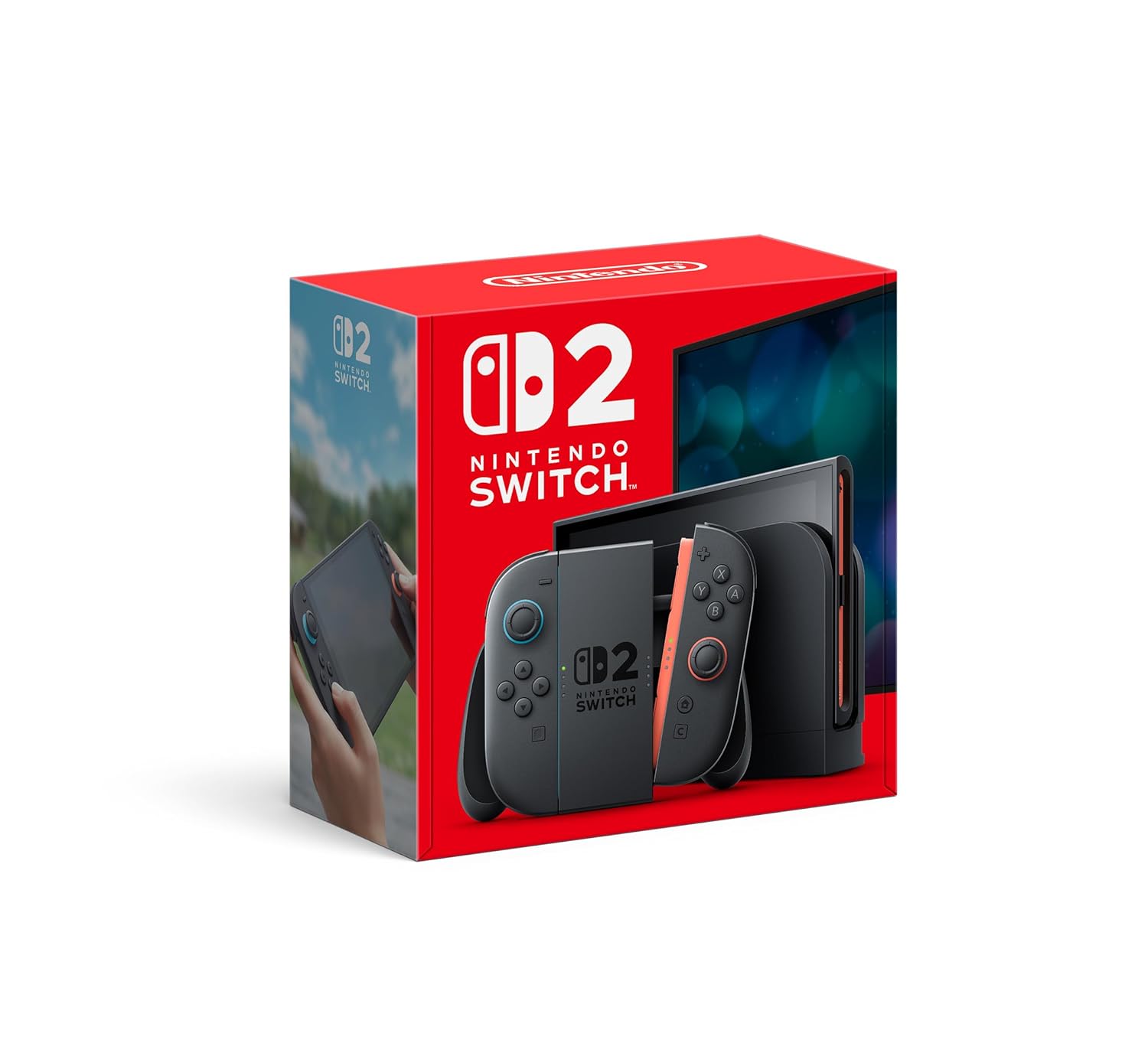
The Nintendo Switch 2 is Nintendo’s follow-up to the original Switch, launched in June 2025 after roughly eight years of the first console’s run. It keeps the same core idea — a hybrid handheld/console you can dock to your TV or play on the go — but pushes the hardware significantly further, with a custom Nvidia chipset offering roughly double the CPU power, triple the RAM, and up to ten times the graphics performance of its predecessor. It launched at $449.99 for the standalone console, or $499.99 bundled with Mario Kart World, and has reportedly shipped nearly 20 million units since release.

Display and Design
The headline hardware upgrade is the screen: a 7.9-inch 1920×1080 LCD panel with HDR, Variable Refresh Rate, and up to 120Hz refresh in handheld mode. Docked, it can output up to 4K at 60fps on your TV. Reviewer opinions on the panel itself are notably split — one outlet described it as “seriously pretty” and said it didn’t feel like a downgrade coming from an OLED handheld, while another called the same panel “lackluster,” pointing to weak motion handling and underwhelming HDR performance. It’s worth keeping that disagreement in mind if display quality is a top priority for you.
Physically, the console measures about 4.5 x 10.7 x 0.55 inches and includes two USB-C ports — the original bottom port plus a new top-side port that supports accessories like the optional Switch 2 Camera.

Joy-Con 2 and New Input Options
The redesigned Joy-Con 2 controllers now attach magnetically instead of sliding onto rails, which makes attaching and detaching noticeably smoother than before. The bigger innovation is a new optical sensor on the base of each Joy-Con that lets it function sideways as a computer mouse when detached. It’s not just a settings-menu gimmick either — some launch-window titles build real mechanics around it, with Nintendo’s wheelchair basketball game Drag x Drive using mouse mode as its primary control scheme.

Backward Compatibility
If there’s one feature reviewers consistently call the console’s biggest selling point, it’s backward compatibility. Save files transfer over through an official tool, meaning anyone with a shelf of original Switch games can jump in without losing progress. Select titles also received Switch 2 Edition upgrades — The Legend of Zelda: Breath of the Wild, for example, got smoother framerates and sharper textures, free for Nintendo Switch Online + Expansion Pack subscribers or as a $9.99 upgrade otherwise (though notably without the original’s Expansion Pass DLC folded in).

Performance and Battery Life
Under the hood, the Switch 2 runs a custom Nvidia Tegra T239 chip with 12GB of RAM and 256GB of internal storage, expandable via microSD Express cards up to 2TB. Performance in testing has been described as comparable to a PlayStation 4 or Xbox One, which is a meaningful jump for a handheld-first device.
Battery life is one area to watch. In testing with Wi-Fi on and automatic brightness while running a graphically demanding title like Zelda: Breath of the Wild – Nintendo Switch 2 Edition, one reviewer got just shy of two and a half hours from a full charge. Nintendo also acknowledged an early glitch affecting how accurately the battery indicator displayed remaining charge shortly after launch.

Price and Value
At $449.99 (or $499.99 bundled with Mario Kart World), the Switch 2 costs considerably more than the original Switch’s $299 launch price back in 2017. Reviewers are largely sympathetic to this given inflation and the scale of the hardware jump, but it’s still a real consideration — especially paired with Nintendo’s game pricing, with titles like Mario Kart World launching at up to $80.
Compared against other current consoles, the Switch 2 lands as one of the more affordable options in its class, and its hybrid nature (something neither PlayStation nor Xbox directly replicates) continues to be its main differentiator.

Pros and Cons
Verdict
The Nintendo Switch 2 delivers exactly what a console generation leap should: substantially more power, a genuinely improved screen, smart new input options with the Joy-Con 2, and — most importantly — a smooth, well-executed bridge from the original Switch’s massive game library. The higher price tag is a real factor to weigh, and battery life during demanding games is worth tempering expectations around, but as a hybrid gaming device, it remains in a category of its own. If you’re invested in the Switch ecosystem or simply want the most capable hybrid console on the market, the Switch 2 is a worthy, if pricier, successor.
Related Posts
Roku Smart TV 40″ Select Series Review: Genuinely Easy to Use, But Picture Quality Is Where It Cuts Corners
Roku Smart TV 40" Select Series Review Overview This review…
WOLFBOX MF50 Electric Air Duster Review — One of the Best Alternatives to Compressed Air?
TheThe WOLFBOX MF50 has become one of the most talked-about…
Deep Vita C Toner Pads Review (2026): Is This K-Beauty Bestseller Worth the Hype?
Packed with 500,000 PPM of vitamin-infused water and a built-in…
