Overview
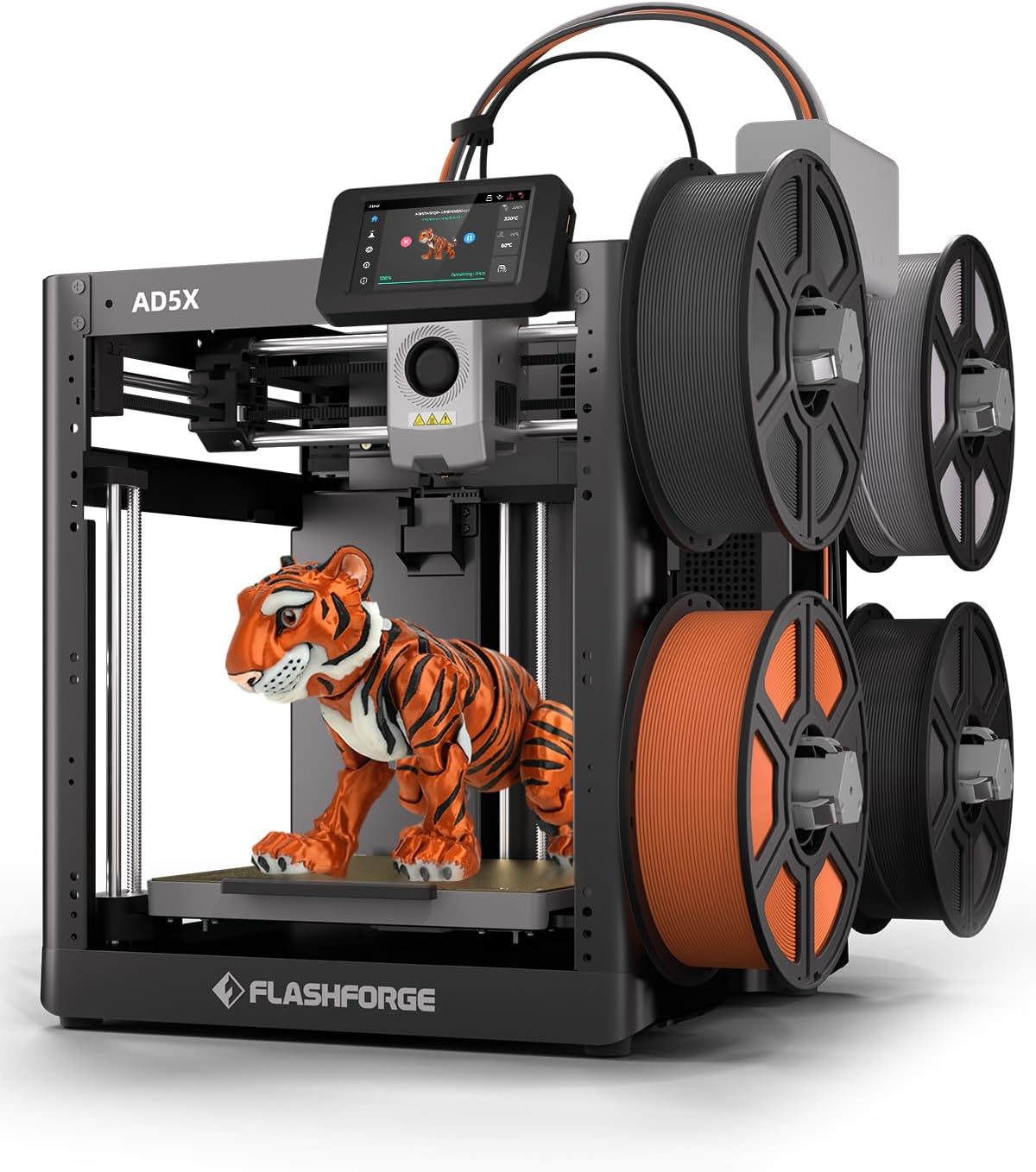
The FlashForge AD5X is the multi-color entry in FlashForge’s Adventurer lineup, built on the same high-speed CoreXY architecture as the AD5M series. Its headline feature is the Intelligent Filament System (IFS) — four side-mounted spool holders that let the printer automatically switch between filaments for true 4-color printing, all fully integrated into the machine with no external feeder box required. It pairs that with a 300°C direct-drive extruder, a 110°C heated bed, a 220x220x220mm build volume, and claimed print speeds of up to 600mm/s with 20,000mm/s² acceleration.
It typically retails around $499, though it’s frequently discounted on Amazon and directly through FlashForge, often landing closer to $349–$379.

Setup and Ease of Use
This is one of the AD5X’s strongest points, especially for first-time users. The printer arrives largely pre-assembled — you remove the packing foam, attach the extruder lines, nozzle, and display, and it’s powered on and running a level check within a few minutes. One reviewer, trying 3D printing for the first time, described going from unboxing to a finished print without needing to understand nozzle sizes, bed temperatures, or filament types beforehand.
The touchscreen menu follows the same beginner-friendly design as the rest of the Adventurer series, using simple icon-based navigation for calibration, filament changes, and print monitoring. That said, at least one reviewer found the touchscreen interface a bit awkward to navigate precisely, relying heavily on small icons rather than clear labels.

Multi-Color Printing and the IFS System
The IFS system is genuinely the centerpiece of this printer, and it mostly delivers on its promise. Reviewers consistently praise how smooth and reliable color switching is in practice, and the side-mounted spool design keeps the printer’s footprint smaller than competing multi-color setups that rely on bulky external feeders. Uniquely for its class, the AD5X also supports multi-color printing with flexible 95A TPU filament right out of the box — a capability most competitors in this price range don’t offer.
The trade-off is filament waste. Every color change requires a purge cycle to clear the previous filament from the nozzle, and on complex, color-heavy prints this can add significant time — one in-depth review noted purge cycles taking nearly five minutes per color change — and a noticeable amount of wasted filament. Experienced users recommend loading the build plate with as many models as possible per print to spread that waste across more output rather than running smaller, more frequent jobs.

Print Quality and Speed
Across multiple independent reviews, actual print quality is rated highly, including with more demanding materials like PLA carbon fiber blends. Testing with a .2mm layer height at around 180mm/s speeds produced clean, detailed results with a noticeably strong finish on CF filaments. FlashForge’s claimed top speed of 600mm/s is aggressive, and while it’s plausible for simpler geometry, most real-world multi-color prints won’t consistently hit that ceiling once purge cycles and color changes are factored in.

Build Quality and Extras
The AD5X uses a sturdy steel frame with linear rod kinematics, comparable to competitors like Creality and Anycubic in build feel. It ships with power-outage recovery rated at a 99% resume success rate, and supports an optional camera accessory for remote print monitoring and time-lapse capture. The frame is open by default, though FlashForge sells a DIY enclosure kit (around $39.99) that adds clear plastic panels for better temperature control with sensitive filaments — a worthwhile add-on given the printer lacks active chamber heating out of the box.
One design quirk worth knowing: discarded purge filament during color changes tends to simply fall out the back of the printer rather than collecting in a built-in waste bin, so plan for some cleanup during multi-color jobs.
Pros and Cons
Verdict
The FlashForge AD5X earns its reputation as one of the most accessible ways into multi-color 3D printing without stepping up to pricier systems. The setup process, print quality, and IFS reliability all punch well above the printer’s discounted street price, and TPU multi-color support is a genuine standout in its class. The real caveat is filament waste — if that’s a dealbreaker for you, it’s worth comparing against pricier alternatives built specifically to minimize purge waste. But for hobbyists and beginners who want vibrant, multi-color prints without a steep learning curve or a huge budget, the AD5X is an easy recommendation.
Related Posts

LEVOIT Core 300 Air Purifier Review (2026): Still the Best Budget Pick?
The LEVOIT Core 300 became the #1 best-selling air purifier…
Marsail Ergonomic Office Chair Review: Solid Adjustability for Under $150
Overview The Marsail Ergonomic Office Chair is a high-back mesh…
Dell 24 Plus Monitor (S2425HSM) Review: A Genuinely Great 144Hz Budget Display
Overview The Dell 24 Plus Monitor (model S2425HSM) is a…
