
The young humpback whale who captured the attention of millions after repeatedly stranding himself along Germany’s Baltic Sea coast has been found dead off the Danish island of Anholt — just two weeks after a controversial privately funded rescue operation released him into the North Sea. His GPS tracker confirmed the identity on Saturday.
The confirmation: a GPS tracker washed ashore
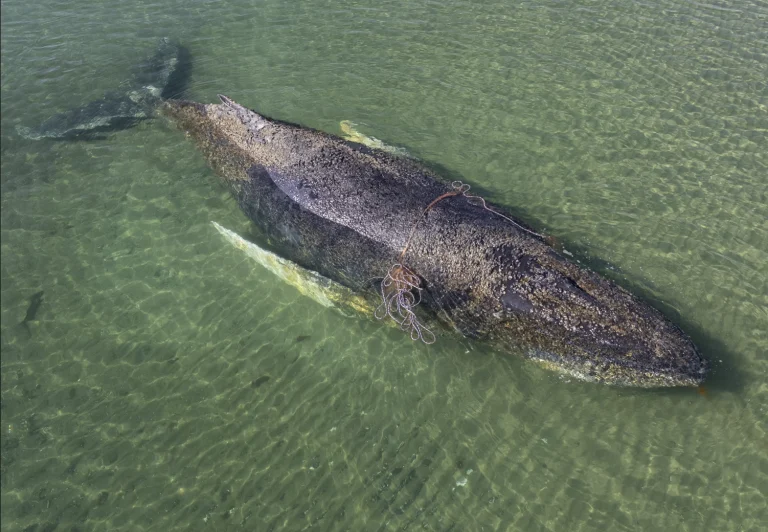
Danish authorities confirmed on Saturday that the humpback whale found dead near the island of Anholt in the Kattegat strait — the broad body of water between Denmark and Sweden — was the same animal known to the public as Timmy. The identification was made after a local employee of the Danish Nature Agency was able to locate and retrieve the tracking device that had been attached to the whale during his rescue in Germany.
“It can now be confirmed that the stranded humpback whale near Anholt is the same whale that was previously stranded in Germany and was the subject of rescue attempts. The position and appearance of the device confirm that this is the same whale that had previously been observed and handled in German waters.”
— Jane Hansen, head of division, Danish Environmental Protection Agency, May 16, 2026
The carcass had first been spotted on Thursday, approximately 130 kilometres south of where Timmy was released on May 2 — meaning the whale had survived for less than two weeks after the rescue. Mecklenburg-Western Pomerania Environment Minister Till Backhaus confirmed the death shortly after the Danish agency’s statement. Danish authorities warned the public not to approach the carcass, citing risks of disease transmission and the danger of internal gas buildup from decomposition causing an explosion.
Who was Timmy — and why did Europe follow his story
Timmy was an adult or subadult male humpback whale, estimated to be a few years old, measuring 12.35 metres in length and weighing approximately 12 tonnes. He was nicknamed “Timmy” by the German tabloid Bild after Timmendorfer Strand, the beach town near Lübeck where he was first spotted stranded on March 23. He also came to be known as “Hope.” Humpback whales are not native to the Baltic Sea — a low-salinity inland sea with shallower depths and different prey availability than the Atlantic Ocean habitats where the species normally ranges. Experts believe Timmy may have entered the Baltic following herring shoals or became disoriented during migration.
His story captivated Germany and much of Europe through weeks of live-streamed rescue attempts, drone footage, and round-the-clock news coverage. At one point, some 50 activists broke through protective fencing to reach the waterfront near where the whale was stranded. The exclusion of marine biologist and social media influencer Robert Marc Lehmann from the official expert team drew significant controversy online. Debates about ghost fishing nets — a topic accelerated by footage of nets entangled around Timmy’s body — reached German parliament.
A timeline of the rescue
March 3Timmy first spotted off the German Baltic coast
March 10Entangled in a fishing net near Steinbeck; freed and escorted out to sea by marine police
March 23Found stranded on a sandbar near Timmendorfer Strand — named “Timmy” by Bild
March 26–28Major rescue operation; whale partially freed himself; restanded multiple times
Mid-AprilAuthorities announce they are giving up rescue efforts; public outcry follows
Late AprilEntrepreneurs Karin Walter-Mommert and Walter Gunz fund €1.5M private rescue; whale coaxed into flooded barge
April 29Barge carrying Timmy crosses into Danish waters heading toward the North Sea
May 1Barge passes Skagen and reaches the North Sea
May 2Timmy exits the barge, dives, resurfaces, and swims away — last confirmed live sighting
May 5Ocean Museum Germany concludes the whale most likely drowned due to exhaustion shortly after release
May 15Whale carcass found off Anholt island, Denmark — identity unconfirmed
May 16GPS tracker confirms: the dead whale is Timmy
The €1.5 million rescue — and the controversy around it
After German authorities announced they had exhausted their options and were suspending official rescue efforts, two private entrepreneurs — Karin Walter-Mommert and Walter Gunz — stepped in to fund a last-ditch attempt estimated to cost €1.5 million. Their plan was unconventional: slowly coax the whale into the flooded cargo hold of a specially prepared barge, seal it, and tow the vessel through the Kattegat and out into the North Sea, where Timmy could be released into waters more suitable for his species.
The operation succeeded mechanically. After initial reluctance, Timmy entered the barge, was transported across the Danish border, passed the northern tip of Denmark at Skagen, and was released into the open North Sea on May 2 — where he surfaced, spouted, and swam away. But the debate about whether the rescue was justified had been running in parallel throughout the entire operation.
“I believe the whale will die very soon now. And I would also like to raise the question: What is actually so bad about that? … Yes, animals live, animals die. This animal is really, really very, very, very sick.”
— Thilo Maack, marine biologist, Greenpeace Germany, speaking to the Associated Press during the rescue operation
Marine biologists who opposed the rescue argued that Timmy was already severely debilitated — he had spent weeks barely moving in shallow water, breathing irregularly, and suffering from a skin condition caused by the Baltic Sea’s abnormally low salinity, which is corrosive to humpback whale skin over time. To its critics, the rescue represented a form of prolonged suffering imposed on a dying animal for the benefit of a watching public. To its supporters, it represented the only chance at survival Timmy had left, and one that was morally obligatory to attempt.
Experts from the Ocean Museum Germany published an assessment on May 5 concluding that the whale had most likely drowned from exhaustion shortly after his release — that the spout seen when he left the barge on May 2 was likely his last act. The GPS tracker, which had been intended to monitor his progress, failed to transmit usable data, leaving Timmy’s final days unknown until the carcass surfaced off Anholt.
What Timmy’s story revealed
Beyond the whale himself, the story exposed the tensions at the heart of wildlife conservation debates: the competing claims of scientific expertise and public emotion; the question of when rescue becomes prolonged harm; the role of private money in determining the fate of wild animals; and the power of social media to transform a stranded whale into a transnational cause. Ghost fishing nets — the discarded or lost gear that had repeatedly entangled Timmy — became a topic of parliamentary discussion in Germany for the first time in years. That, at least, was a consequence Timmy’s story will leave behind.
Related Posts

Andes Hantavirus Explained: Rare Human Transmission Case Raises Global Health Concerns
A rare strain of hantavirus known as the Andes virus…
Fed May Delay Rate Cuts Until 2027 as Inflation Risks Persist
The U.S. Federal Reserve is expected to keep interest rates…

Amazon CEO Says Gen Z Must “Pay Their Dues” to Grow Professionally
Amazon CEO Andy Jassy recently shared his perspective on career…
