The United States Army carried out yesterday (15) the first fully autonomous landing of a CH-47F Chinook helicopter without any pilot intervention. The test, conducted with technology from Boeing, used the Approach-to-X system, which allows the aircraft to perform approach and landing precisely and automatically, representing a significant advancement in military aviation.
During the tests, which began in January 2026, the system had already completed more than 150 automatic approaches, with an error margin of less than 1.5 meters. The goal is to reduce pilot workload in complex scenarios, especially in hostile environments or low-visibility conditions, where landing requires a high level of attention and precision.
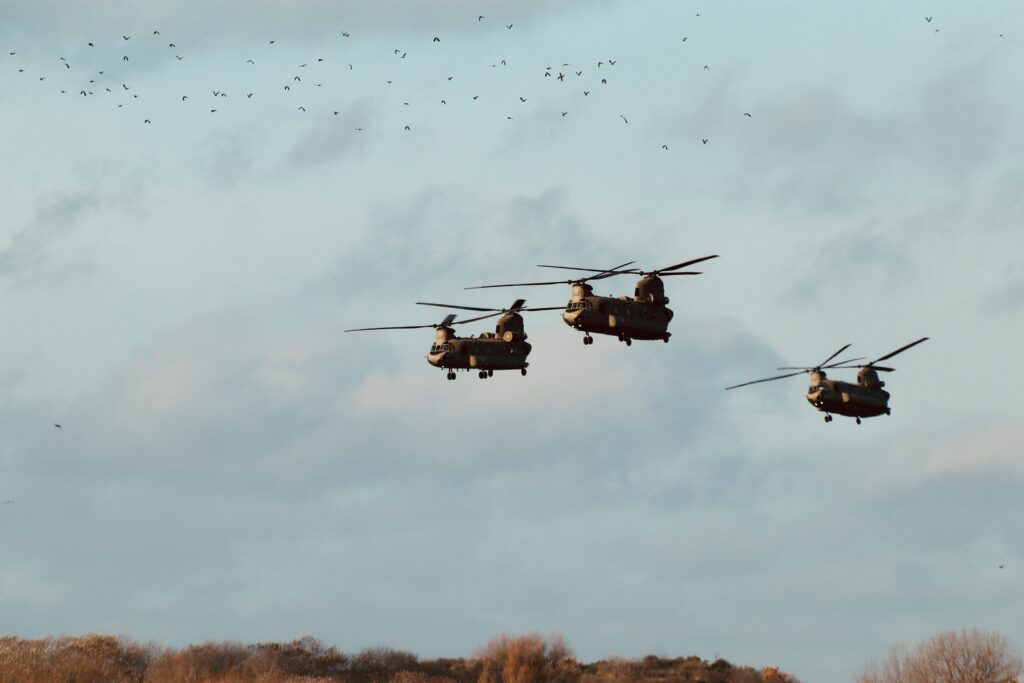
How does autonomy work on the Chinook?
Unlike fully independent systems, the technology applied to the Chinook works as a layer of supervised autonomy. This means that pilots still define important parameters, such as the landing zone and trajectory, while the system takes control of flight commands to execute the maneuver based on that data.
The solution combines advanced algorithms, precision navigation, and real-time adjustments to replicate human behavior during landing. At the same time, it maintains the possibility of immediate crew intervention, ensuring flexibility in unexpected situations, such as terrain changes or threats in the environment.
This advancement reinforces a trend in the armed forces to integrate autonomy into existing platforms rather than relying solely on new equipment. In the case of the Chinook, one of the main heavy-lift transport helicopters of the United States, the upgrade is done via software, which aims to reduce costs and speed up implementation.
With new tests planned for different operational conditions, including hostile environments and electronic interference, the expectation is that the system will evolve rapidly in the coming years. If you are interested in how technology is redefining critical areas such as defense, mobility, and intelligence.
Related Posts

Knicks escape San Antonio 105–104 in a Finals thriller — KAT goes off, Bridges is ice-cold down the stretch
With Brunson ice-cold (7/25 FG), New York needed Karl-Anthony Towns…
Trump blames Iran for downing U.S. Apache helicopter near Hormuz — both crew rescued by Navy drone boat in a military first
An AH-64 Apache attack helicopter went down off the coast…

Five Italian Divers Die After Cave Diving Accident in the Maldives
Authorities in the Maldives are investigating a tragic cave diving…
