Philips Avent Natural Response Nipple Review (Flow 1, 4-Pack)

Overview
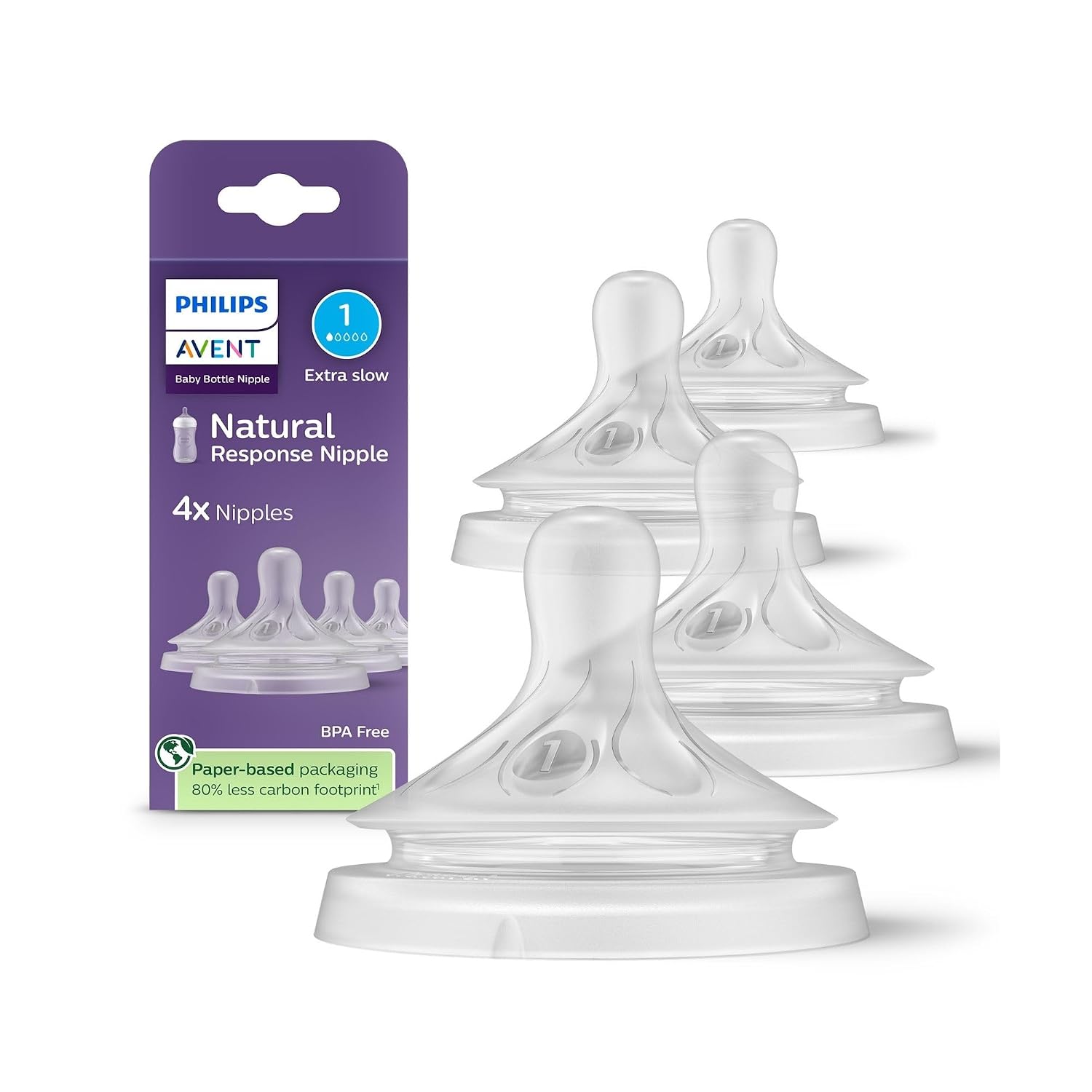
This review covers the specific product listed under this ASIN: the Philips Avent Natural Response Nipple, Extra Slow Flow (Flow 1), 4-pack, model SCY961/44, made of soft, clear silicone. It’s worth being precise here, since Philips Avent’s Natural Response line spans five flow levels (Flow 1 through Flow 5), and this specific listing is the slowest, entry-level flow, generally intended for newborns just starting out with a bottle. These nipples are compatible only with Philips Avent Natural bottles (plastic or glass) — they are not interchangeable with Philips’ separate AirFree Vent line or with other brands’ bottles.
One detail worth flagging clearly for anyone comparing older Avent products to this one: Philips has moved away from a strictly age-based flow labeling system (e.g., “0m+”) toward what the company calls a pace-based flow navigation system, numbered Flow 1 through Flow 5. The practical guidance is straightforward — start with whichever nipple came with your bottle, size down if milk is leaking from your baby’s mouth or they’re gulping, and size up if your baby seems frustrated or is playing with the nipple rather than actively drinking. If you’re used to the older age-range labeling, this is a genuine (if minor) adjustment, but it’s arguably a more accurate system since babies develop at different paces regardless of age.
How the Paced-Flow Design Works
This is the core feature that differentiates the Natural Response line, and it’s worth explaining clearly. Rather than relying purely on a fixed hole size the way many standard bottle nipples do, the nipple’s opening and internal design are engineered to release milk only when the baby is actively, actively sucking — mimicking how milk flow naturally pauses during breastfeeding when a baby stops to swallow or breathe. Philips also includes an anti-colic valve, similar in purpose (though simpler in construction) to systems like Dr. Brown’s, designed to direct air away from the baby’s stomach during feeding to help reduce colic and discomfort.
Real-World Feeding Performance
This is where the product earns consistently strong, specific praise across a wide range of parent reviews collected on Walmart and Philips’ own site, which is worth taking seriously given how numerous and specific the positive feedback is. Multiple reviewers independently praised the near-total absence of dripping or leaking, even when bottles were shaken vigorously to mix formula — a meaningful point of contrast with some competing anti-colic systems (including Dr. Brown’s Options+, which independent sources note can leak more readily under shaking). Several parents specifically credited the nipple and venting design with eliminating gas, colic, and fussiness entirely for their babies, across both breastmilk and formula feeding.
The design is also frequently praised for easing breast-to-bottle transitions — several reviewers, including parents of exclusively breastfed babies, described their child switching between breast and this nipple without confusion or resistance, which is precisely the use case Philips designed the “Natural Response” line around. One recurring, minor piece of feedback: a few reviewers noted the silicone itself feels slightly firm, and that some babies took a moment to adjust to the wider nipple shape before settling into a comfortable latch — a small adjustment period rather than a lasting issue for most.
Ease of Cleaning: A Genuine Advantage
This is a real, practical strength worth highlighting on its own. Compared to more complex anti-colic systems like Dr. Brown’s (which involves multiple internal vent pieces), the Natural Response nipple and accompanying Philips Avent Natural bottle use a genuinely simple assembly — just the bottle, nipple, and a retaining ring/cap, with no separate internal vent components to disassemble and scrub. Multiple reviewers specifically called this out as a meaningful time-saver during the exhausting early weeks of feeding, without giving up meaningful anti-colic performance in their experience.
How It Compares
This is where a fully honest review needs to include some balance rather than only positive feedback. Mommyhood101’s comparative testing, while generally positive on the Philips Avent Natural line, found its venting system not quite as effective as Comotomo’s silicone bottle system in their side-by-side evaluation — a reasonably specific, credible critique from an outlet that tests multiple bottle brands directly against each other rather than reviewing in isolation.
More broadly, independent buying guides converge on a consistent, useful framing: Reviewed (formerly of USA Today) names the Philips Avent Natural line their “Best Value” pick among bottles they tested, citing its range of sizes, flows, and materials at a lower price than premium competitors. A more recent, detailed comparison guide frames it similarly — not necessarily the single “best overall” bottle, but specifically the strongest pick for combo feeding (switching between breast and bottle), thanks to its genuinely breast-like, paced-flow mechanics. That same guide names Comotomo its overall top pick for breastfed babies, and Dr. Brown’s Options+ as the strongest choice specifically for gassy or reflux-prone babies with more clinical backing behind its vent system. In other words: this is a genuinely well-regarded product, but it’s most accurately understood as the smart value and combo-feeding choice within a competitive field, rather than the single undisputed best bottle nipple on the market for every use case.
Sustainability Note
A small but genuinely positive detail: Philips has shifted its nipple packaging from plastic cases to 100% responsibly sourced paper packaging, which the company states results in roughly 300 tons less plastic used annually across its nipple pack sales and a meaningful reduction in fossil fuel use in manufacturing. It’s a modest environmental improvement, but a real one, and reflects a broader packaging shift you may notice if you’re used to older Avent nipple packaging.
Pros and Cons
Verdict
The Philips Avent Natural Response Nipple, Extra Slow Flow, is a genuinely well-regarded, practical choice — particularly well-suited to parents combo-feeding between breast and bottle, thanks to paced-flow mechanics that closely mimic natural breastfeeding rhythm. Its simplicity (fewer parts, easy cleaning) and strong anti-leak performance are real, consistently reported strengths, and its positioning as a “best value” pick among independent buying guides is well-earned. It’s not necessarily the single best option for every situation — Comotomo edges it out in some comparative venting tests, and Dr. Brown’s Options+ carries stronger clinical backing specifically for gassy or reflux-prone babies — but for most parents looking for an affordable, easy-to-use, breastfeeding-compatible nipple, this is a smart, well-tested pick.

Related Posts
Shark HV322 Rocket Pet Plus Review (2026): Still Worth It?
The Shark HV322 Rocket Pet Plus is one of the…
Shark HV322 vs Dyson V8 vs Dyson V11 (Full Comparison 2026
🔝 Products Compared 📊 Comparison Table FeatureShark HV322Dyson V8Dyson V11TypeCordedCordlessCordlessSuction…
AstroAI Digital Tire Pressure Gauge Review: Accurate, Simple, and Hard to Beat for the Price
Overview The AstroAI Digital Tire Pressure Gauge is a compact,…
