
Nintendo Switch OLED – Tears of the Kingdom Edition Review
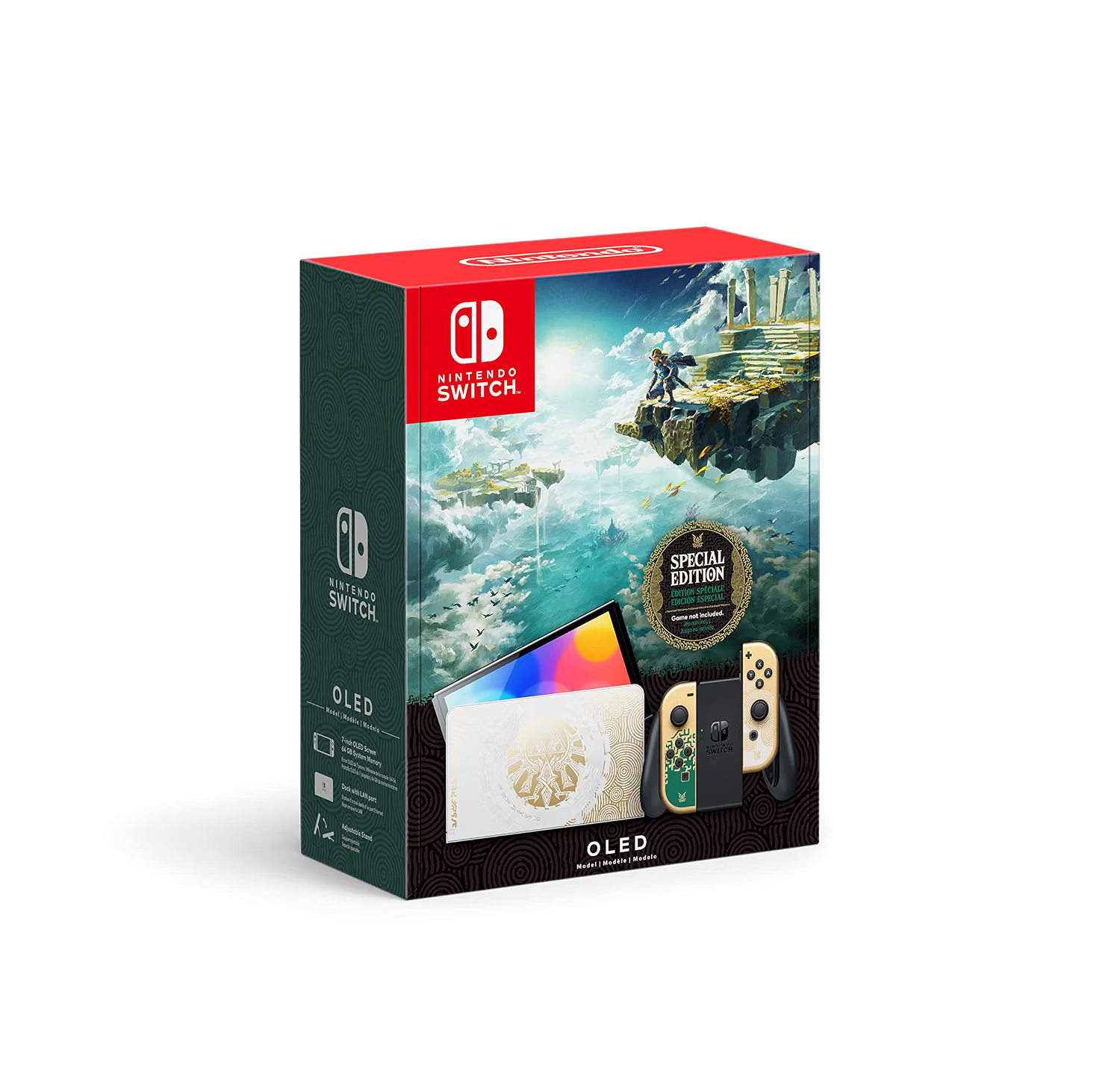
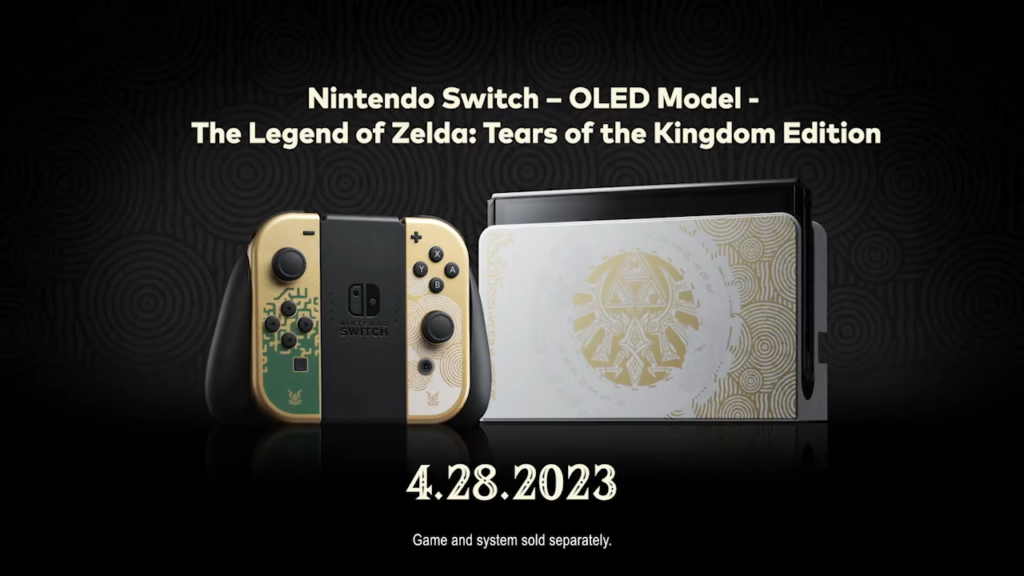
This is Nintendo’s special-edition OLED console themed around The Legend of Zelda: Tears of the Kingdom — a glossy white dock decorated with gold Hylian crest artwork, green-and-gold Joy-Con controllers, and a matching pattern on the back of the console itself. Before anything else: this is a console-only purchase. The Tears of the Kingdom game is not included and needs to be bought separately, despite the console’s name and theme leading a lot of shoppers to assume otherwise — a genuinely easy mix-up on a listing like this, so double-check before you buy if you were expecting the game in the box.
Hardware-wise, this is the same Switch OLED model Nintendo has sold since 2021, just with cosmetic changes: a 7-inch OLED screen (up from 6.2 inches on the original Switch), 64GB of internal storage (double the base model’s 32GB), an improved wide kickstand for tabletop play, enhanced speakers, and a redesigned dock with a wired LAN port for stable online play. It does not include improved processing power — same chipset, same 720p handheld / 1080p docked output as the base Switch. The extra $50 over the standard model buys you a better screen and more storage, not more performance.
What reviewers consistently praise
Across TechRadar, Tom’s Guide, and CNET’s original 2021 reviews, the consensus has been remarkably stable for years: the OLED screen is the single best reason to choose this model. It delivers noticeably richer color, deeper black levels, and sharper contrast than the LCD screen on the base Switch, and it makes Nintendo’s colorful, stylized art direction — think Zelda, Mario, Kirby — genuinely pop in a way that’s obvious the moment you pick it up. Tom’s Guide called it a strong recommendation for anyone who’s been on the fence about getting a Switch. The improved kickstand is a smaller but appreciated upgrade too, since the original Switch’s flimsy stand was a common complaint for tabletop play.
The honest caveat: Joy-Con drift
No honest review of any Switch model can skip this. Joy-Con drift — where the analog stick registers phantom movement without being touched — has been a documented, high-profile issue since the original Switch launched in 2017, serious enough to prompt a formal apology from Nintendo’s president, multiple class-action lawsuits in the US, and an investigation by the UK’s Which? consumer group that identified wear on the joystick’s circuit board contacts as a likely design flaw rather than just rough handling. When the OLED model launched, Nintendo confirmed directly to press that the Joy-Con hardware itself was unchanged from the standard model, and the company’s own engineers have stated publicly that some degree of wear is basically unavoidable given the stick’s physical design, even while claiming incremental reliability improvements. In plain terms: buying the OLED does not mean you’re getting drift-proof controllers. It’s a real, still-relevant risk worth knowing about rather than something Nintendo has quietly fixed.
The bigger question in 2026: does this still make sense?
This is the part that matters most for anyone shopping right now. The Nintendo Switch 2 has launched, and multiple recent reviews are direct about where that leaves the OLED: it’s no longer the automatic recommendation for first-time buyers that it used to be. One 2026 review put it plainly — if you don’t own any Switch yet, the Switch 2 is the more sensible pick thanks to a real performance leap, a bigger 120Hz screen, magnetic Joy-Con attachments that finally fix a years-old annoyance, and full backward compatibility, so you’re not losing access to the existing library by choosing the newer machine.
Where the OLED still earns a legitimate recommendation, according to the same wave of 2026 coverage, is for buyers who specifically value screen quality and price over raw power: the OLED’s screen technology is actually richer in color and contrast than the Switch 2’s larger LCD panel, and at roughly $100 less, it remains the better-looking, better-value way into the existing Switch game library if you don’t need 4K docked output or top-tier performance. If you already own a launch Switch or a earlier revision and are considering upgrading, most 2026 reviewers frame the Switch 2 as the more worthwhile jump; if you’re choosing between a brand-new OLED and a brand-new Switch 2 as your very first Nintendo hybrid console, it comes down to whether the OLED screen and lower price matter more to you than raw performance and 4K docked output.
For this specific Zelda-themed edition, there’s an added wrinkle: special editions like this tend to be limited production runs, so pricing and availability can swing based on collector demand rather than pure hardware value — worth factoring in if you’re paying above the standard OLED’s retail price purely for the design.
Pros and Cons
Verdict
Taken purely as hardware, the Switch OLED remains a genuinely well-made console, and this Zelda-themed edition is one of the better-looking special editions Nintendo has released — the screen alone still justifies the model over the base Switch for anyone buying into the ecosystem today. But go in with clear eyes on two things: you’re not getting the Tears of the Kingdom game bundled in in the box, and you’re buying older hardware in a marketplace that now includes the Switch 2. If a great screen, a lower price, and access to the current Switch library is genuinely what you’re after — and you don’t need the Switch 2’s extra horsepower or 4K docked output — this is still a smart, attractive buy, Joy-Con drift risk and all. If you’re looking for the best long-term investment or don’t already have strong feelings about the older Switch ecosystem, it’s worth comparing directly against the Switch 2 before you commit.
Related Posts

Elite Gourmet ESB-301BF Electric Burner Review: A Solid, Simple Hot Plate for the Right Job
Elite Gourmet ESB-301BF Electric Burner Review Overview This review covers…
Xbox Series X Review: Is Microsoft’s Console Still Worth Buying in 2026?
The Xbox Series X remains one of the most powerful…

Nintendo Switch (Neon Blue/Red) Review: Still Worth Buying in 2026?
Review Launched back in March 2017, the original Nintendo Switch…
