A new scientific study concludes that Campi Flegrei — one of the world’s most dangerous volcanic systems, located just west of Naples — is accelerating toward a critical transition within the next decade. Researchers cannot yet determine whether that transition will be a major eruption or a less destructive change in the volcano’s internal structure. Either way, the consequences for one of Europe’s most densely populated volcanic zones would be severe.
What the new study found
A peer-reviewed preprint published in late May 2026 by researchers led by Davide Zaccagnino, a postdoctoral researcher in geological hazards at the Southern University of Science and Technology in Guangdong, China, concludes that Campi Flegrei is accelerating toward a critical transition — most likely within the next decade. The paper analyzes long-term seismic, deformation, and geochemical data to model the internal state of the caldera and identify the trajectory of its current unrest phase, which has been intensifying since the late 1990s and has significantly accelerated since 2005.
“Our paper identifies when the system is likely to reach a breaking point, but it cannot determine what will happen at that breaking point with the current data.”
— Davide Zaccagnino, lead author, Southern University of Science and Technology, Guangdong
The key finding is not that an eruption is imminent or certain — but that the system is on a trajectory that will, within a timeframe measurable in years rather than centuries, reach a point where something significant changes. That change could take the form of a major explosive eruption, or it could manifest as a structural reorganization of the volcano’s internal plumbing — a hydrothermal event, a phreatic explosion, or a subsidence episode — that would still cause catastrophic disruption without a full magmatic eruption.
What Campi Flegrei is — and why it is so dangerous
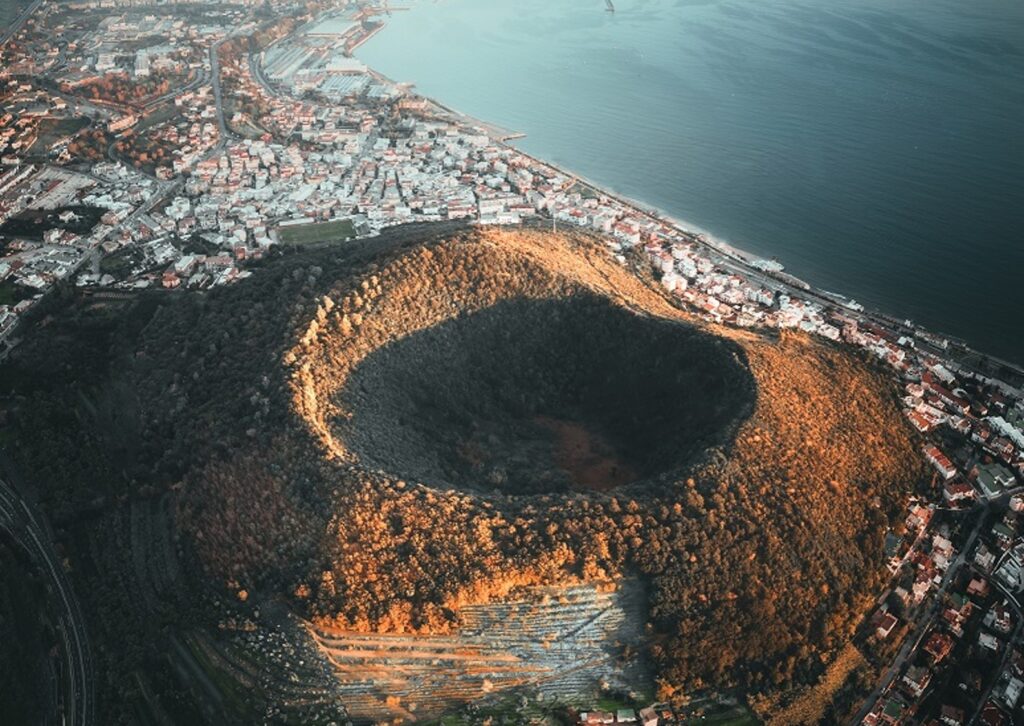
Campi Flegrei, known in English as the Phlegraean Fields, is a large volcanic caldera approximately 15 kilometres in diameter located directly west of Naples in southern Italy. It is not a single cone-shaped volcano but a collapsed caldera — a broad depression formed when a massive eruption approximately 40,000 years ago caused the ground above the magma chamber to collapse inward. Smaller eruptions have occurred since, including an explosive event in 1538 that built Monte Nuovo, a 132-metre cinder cone, in a matter of days.
The caldera is home to approximately 500,000 people, including the residents of the town of Pozzuoli and the western suburbs of Naples. The city of Naples itself, with a metropolitan population of approximately 3 million, sits directly adjacent to the caldera’s eastern boundary. An eruption of moderate to large scale would trigger mandatory evacuation of hundreds of thousands of people, potentially displace millions across the broader Naples metropolitan area, and cause severe disruption to southern Italy’s infrastructure and economy.
Campi Flegrei — key facts
Location West of Naples, Campania, southern Italy
Type Supervolcanic caldera — 15 km diameter
Last major eruption 1538 — Monte Nuovo cinder cone formation
Caldera formation ~40,000 years ago — catastrophic eruption
Population at risk ~500,000 within caldera; 3 million in greater Naples area
Current alert level Yellow (Italy’s INGV) — elevated but not imminent eruption
Ground uplift since 2005 More than 120 cm of cumulative bradyseism (ground deformation)
Estimated breaking pointWithin the next decade (new study) — exact timing uncertain
Bradyseism — the slow-motion warning sign
Campi Flegrei is best known scientifically for a phenomenon called bradyseism — the slow, cyclical rising and sinking of the ground above the magma system, caused by the movement of hydrothermal fluids and gases through the volcano’s internal structure. The ground beneath Pozzuoli has risen and fallen by metres over centuries, and the ancient Roman marketplace of Serapeum — whose columns bear the distinctive bore-holes of marine mollusks — serves as a historical record of how dramatically sea level has changed relative to the land in this area.
Since 2005, Campi Flegrei has been in a sustained uplift phase. The ground has risen by more than 120 centimetres in the Pozzuoli area over the past two decades — the most sustained and significant bradyseism episode recorded since the crisis of the 1980s, when the Italian government evacuated approximately 40,000 residents from Pozzuoli amid fears of an imminent eruption that ultimately did not occur. The current uplift is accompanied by increasing seismic activity: earthquake swarms have become more frequent and, in some cases, more energetic, with a magnitude 4.4 earthquake in September 2023 causing structural damage to buildings in the area.
What “breaking point” means — and what it doesn’t
The language of the new study is precise and worth parsing carefully. The researchers identify a “breaking point” — a threshold in the physical state of the volcanic system beyond which the current trajectory cannot continue without some form of release. But they explicitly state they cannot yet determine what form that release will take. The range of possible outcomes includes, at the less severe end, a purely hydrothermal event — steam explosions driven by superheated groundwater, without magma reaching the surface — and, at the more severe end, a magmatic eruption of varying scale and intensity.
Italy’s National Institute of Geophysics and Volcanology (INGV) monitors Campi Flegrei continuously and maintains the caldera at a Yellow alert level — elevated but not indicating an imminent eruption. INGV scientists have previously described the current unrest as consistent with long-term volcanic activity that does not necessarily precede an eruption in the near term, while acknowledging that the system’s behavior is not fully predictable with current scientific tools.
⚠️ Important context: The new study is a preprint — it has not yet completed formal peer review and publication in a scientific journal. The finding that Campi Flegrei is approaching a “breaking point” reflects a modeled trajectory based on current data. It does not mean an eruption is imminent, certain, or predictable on a specific timeline. Italy’s INGV alert level for Campi Flegrei remains Yellow.
Emergency planning — Italy’s ongoing preparedness effort
Italy’s Civil Protection Department has maintained an active emergency plan for Campi Flegrei for decades, updated most recently in 2023. The plan identifies a “red zone” — the area that would require immediate evacuation in the event of a volcanic crisis — covering approximately 500,000 residents across 13 municipalities. Evacuation exercises have been conducted periodically, most recently in 2023, testing the logistics of moving large numbers of people out of the caldera area within the limited time window that a volcanic crisis might provide.
The challenges are significant. The red zone includes some of the most densely built and socioeconomically complex urban areas in southern Italy, and the logistics of evacuating half a million people from a region with limited road capacity are formidable. Italy’s experience with the 1980s bradyseism crisis — when a full evacuation of Pozzuoli was ordered and later reversed — has shaped a planning approach that emphasizes graduated response rather than pre-emptive mass evacuation, a strategy that reduces economic disruption but compresses the response window if a crisis escalates rapidly.
What scientists are watching
The key variables being monitored by INGV and international volcanologists include the rate and distribution of ground deformation, the composition and volume of volcanic gases venting from fumaroles in the Solfatara crater area, the frequency and depth distribution of seismic events, and any changes in the thermal output of the hydrothermal system. A shift toward shallower earthquakes, an increase in magmatic gas ratios relative to hydrothermal gases, or an acceleration in the rate of ground uplift would all represent significant warning signals that the system is moving toward the more severe end of the possible outcome range.
For now, the new study adds mathematical rigor to what volcanologists have observed qualitatively for years: Campi Flegrei is not dormant, it is not stable, and its current trajectory is not consistent with indefinite continuation of the status quo. The question is not whether the system will reach a breaking point — according to the new research, it will. The question is what happens when it does.
Related Posts

US Awaits Iran Response on Peace Deal as Marco Rubio Signals Critical Turning Point in Middle East Crisis
The United States is awaiting Iran’s official response to a…

Wall Street Futures Fall as Investors Monitor Iran War Negotiations and Oil Market Volatility
US stock futures moved lower on Thursday as investors closely…
US Warns of Military Response to Mine Threats in Strait of Hormuz
The United States has issued a strong warning regarding maritime…
