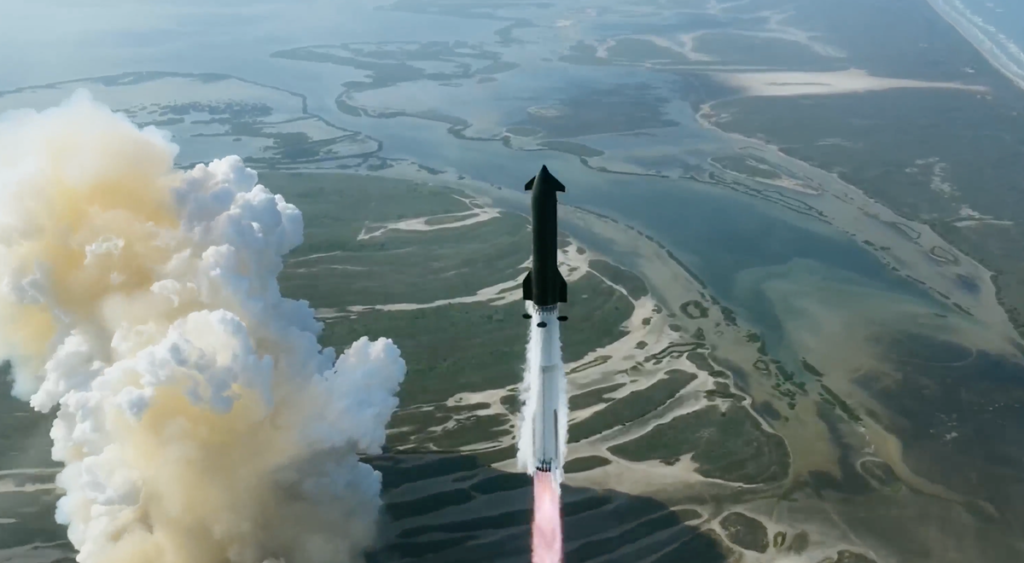
The world’s largest and most powerful rocket lifted off from a new launch pad at Starbase, Texas, on Friday evening, completed a blazing atmospheric re-entry, and splashed down in the Indian Ocean — achieving all major objectives in Starship’s 12th overall test flight and first for the upgraded V3 configuration.
What happened on Friday
SpaceX on Friday completed the 12th uncrewed test flight of its next-generation Starship, a high-stakes trial run of a newly upgraded version of the spacecraft as Elon Musk’s rocket company nears a record-breaking public listing. The towering vehicle blasted off at about 5:30 p.m. CT from SpaceX facilities in Starbase, Texas, on the Gulf of Mexico near Brownsville, and the test ended about an hour later when the Starship vehicle made it through a blazing re-entry through Earth’s atmosphere and splashed down into the Indian Ocean, nose up as planned.
SpaceX successfully met all goals the company said it was aiming for. The launch was the first of the company’s V3 version of both the booster rocket and the upper stage “Ship,” which is a key part of NASA’s Artemis series of missions to the moon and, potentially, to Mars. The launch also marked the first blast-off from a new launch pad — Orbital Launch Pad 2 — designed for the more powerful rocket.
Mission profile — Flight 12 at a glance
Mission designation Starship Flight 12 — first V3 test flight
Launch date/time Friday, May 22, 2026 — 5:30 PM CT (22:30 UTC)
Launch site Orbital Launch Pad 2, Starbase, Texas (first use)
Vehicle Starship V3 upper stage + Super Heavy V3 booster
Vehicle height 124.4 metres — over 40 stories tall
Liftoff thrust 80,800 kilonewtons (Super Heavy booster)
Payload capacity (LEO)100,000 kg
Payloads carried 22 test payloads (uncrewed)
Flight duration Approximately 1 hour
Splashdown Indian Ocean — nose-up, as planned
Overall result “Delivered” — all major objectives met (SpaceX)
What V3 changes — and why it matters
The debut flight of Starship V3 was designed to enable more frequent Starlink satellite launches and to send future NASA missions to the moon, marking a key milestone for the vehicle following months of testing delays. The V3 iteration incorporates dozens of hardware and software upgrades to both the Super Heavy booster and the Starship upper stage, aimed at improving reliability, increasing payload capacity, and reducing the turnaround time between flights — the metric most critical to SpaceX’s goal of making Starship economically viable as a commercial launch vehicle.
Starship, which SpaceX has spent more than $15 billion developing as a fully reusable spacecraft, is critical to Musk’s goals of cutting launch costs, expanding his Starlink business, and pursuing ambitions ranging from deep-space exploration to orbital data centers. The V3’s increased payload capacity — 100 metric tonnes to low Earth orbit, compared to V2’s approximately 80 tonnes — directly enables the denser Starlink satellite deployments needed to expand the constellation and the heavier configuration required for NASA’s Artemis lunar lander missions.
What worked — and what was mixed
✓ Achieved
- Successful launch from new Pad 2
- Clean ascent and stage separation
- Super Heavy boostback burn
- Controlled atmospheric re-entry
- Nose-up Indian Ocean splashdown
- All 22 test payloads deployed
- All primary mission objectives met
⚠ Mixed / TBD
- Super Heavy booster not caught by tower arms — splashdown in Gulf
- Starship upper stage not caught — Indian Ocean splashdown
- Full reusability not demonstrated on V3 debut
- Post-flight data analysis ongoing
The IPO connection — timing that could not be more deliberate
The outcome could sway investor confidence ahead of SpaceX’s initial public offering next month, expected to be the largest in history. SpaceX filed its IPO prospectus with the SEC on Wednesday, May 20 — just 48 hours before Friday’s launch — targeting a valuation of $1.75 to $2 trillion and seeking to raise approximately $75 billion. SpaceX was counting on a successful test flight to reinforce its case that Starship, the world’s largest and most powerful rocket ever flown, is nearing commercial readiness after years of explosive setbacks and development delays.
The sequencing is almost certainly deliberate. A successful V3 debut flight, documented in live SpaceX webcast footage and independently verified by Reuters, UPI, and CNN, provides concrete evidence for roadshow investors that the $15 billion development program is producing a functional vehicle. The IPO roadshow begins June 4, pricing is expected June 11, and the listing on Nasdaq under “SPCX” is targeted for June 12.
12th
Overall Starship test flight since 2023
$15B+
Total SpaceX investment in Starship development
100T
V3 payload capacity to LEO (metric tonnes)
The road to this moment — a history of delays and explosions
SpaceX hit a major setback when a Starship spacecraft exploded during a ground test in June 2025, spurring an emergency response from nearby authorities in Brownsville, Texas. The V3 debut had been delayed multiple times this year: Musk first indicated in January that Starship was on track for a March liftoff, revised to April at the start of March, and then to May in early April. Each delay pushed the launch closer to the IPO window, increasing the stakes of both the technical and the commercial outcome.
Friday’s successful flight closes that chapter. With all primary objectives met, SpaceX enters its IPO roadshow with verified V3 flight data, a functional new launch pad, and a vehicle that — for the first time — demonstrated the full profile required for NASA’s Artemis lunar lander missions.
What comes next
SpaceX will analyze flight data before announcing the next test date. The primary technical objective for upcoming flights is demonstrating full hardware reusability — catching both the Super Heavy booster and the Starship upper stage with the launch tower’s “mechazilla” arms rather than splashing them down. That capability is essential for achieving the rapid launch cadence SpaceX needs to make Starship commercially viable. With the IPO roadshow beginning in less than two weeks, the next Starship milestone may be the listing itself rather than another test flight.
Related Posts

New Sexual Violence Allegations Reignite Epstein Scandal in the United Kingdom
New allegations involving sexual violence are reportedly shaking investigations connected…
Russian Cargo Ship Carrying Suspected Nuclear Reactors for North Korea May Have Been Sabotaged in Mediterranean Incident
A Russian cargo vessel that mysteriously sank near the Spanish…

US Releases Secret UFO Files and Extraterrestrial Research Records
The United States government has officially begun releasing previously classified…
